missing translation for 'onlineSavingsMsg'
Learn More

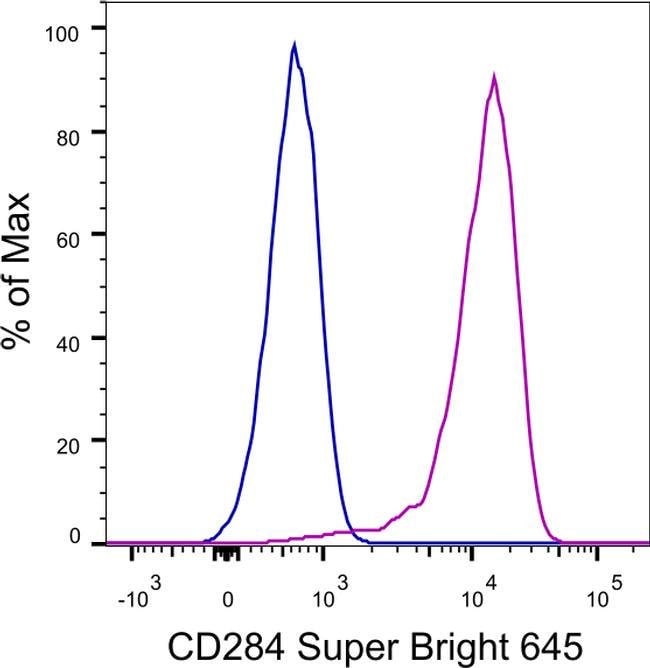
Invitrogen™ CD284 (TLR4) Monoclonal Antibody (HTA125), Super Bright™ 645, eBioscience™, Invitrogen™
GREENER_CHOICE

Catalog No. 64991742
Encompass
Change view
Click to view available options
Quantity:
100 Tests
1 product options available for selection
Product selection table with 1 available options. Use arrow keys to navigate and Enter or Space to select.
Catalog No. Quantity
64991742 100 Tests
Use arrow keys to navigate between rows. Press Enter or Space to select a product option. 1 options available.
1 options
Catalog No. 64991742 Supplier Invitrogen™ Supplier No. 64991742
Only null left

Mouse Monoclonal Antibody

Description: The 7E.17G9 monoclonal antibody reacts with mouse ICOS (Inducible COStimulatory molecule), a T cell specific molecule and a third member of the CD28/CTLA-4 family. A homodimer of 47-57 kDa, ICOS is expressed on activated T cells, has potent costimulatory activity for T cell activation and proliferation and is required for humoral immune response. ICOS binds to its ligand on activated APC including B cells called B7h/B7RP-1 and is thought to play a protective role in inflammatory autoimmune diseases. ICOS may be involved in the development of Th2 cells. Applications Reported: This 7E.17G9 antibody has been reported for use in flow cytometric analysis. Applications Tested: This 7E.17G9 antibody has been tested by flow cytometric analysis of mouse splenocytes. This may be used at less than or equal to 0.5 μg per test. A test is defined as the amount (μg) of antibody that will stain a cell sample in a final volume of 100 μL. Cell number should be determined empirically but can range from 10^5 to 10^8 cells/test. It is recommended that the antibody be carefully titrated for optimal performance in the assay of interest. Super Bright 645 is a tandem dye that can be excited with the violet laser line (405 nm) and emits at 645 nm. We recommend using a 660/20 bandpass filter. Please make sure that your instrument is capable of detecting this fluorochrome.

TLR4 is member of the Toll like receptor (TLR) family which plays a fundamental role in pathogen recognition and activation of innate immunity. TLRs are highly conserved from Drosophila to humans and share structural and functional similarities. This receptor is most abundantly expressed in placenta, and in myelomonocytic subpopulation of the leukocytes. Mammalian cells respond to LPS by activating TLR4. TLR4 belongs to the multi-protein complex of lipopolysaccharide (LPS) receptor, containing CD14, LY96 and TLR4, and is involved in signal transduction events induced by lipopolysaccharide (LPS) found in most gram-negative bacteria. TLR4 aids in the recognition of pathogen-associated molecular patterns (PAMPs) that are expressed on infectious agents, and mediate the production of cytokines necessary for the development of effective immunity. The various TLRs exhibit different patterns of expression. Mutations in the TLR4 gene have been associated with differences in LPS responsiveness. Also, several transcript variants of the TLR4 gene have been found, but the protein coding potential of most of them is uncertain. TLR4 is expressed by peripheral blood monocytes and a small population of B-cells and is also expressed in human placenta. Studies with TLR4-deficient mice indicate that the main ligand for TLR is lipopolysaccharide. Consequently, these mice also showed increased susceptibility to Gram-negative sepsis.

Specifications

Antigen CD284 (TLR4)
Applications Flow Cytometry
Classification Monoclonal
Clone HTA125
Concentration 5 μL/Test
Conjugate Super Bright 645
Formulation PBS with BSA and 0.09% sodium azide; pH 7.2
Gene TLR4
Gene Accession No. O00206
Gene Alias ARMD10; CD284; EGK_07381; homolog of Drosophila toll; hToll; lipopolysaccharide response; Lps; Ly87; Ran/M1; Rasl2-8; Tlr4; TLR-4; TOLL; toll like receptor 4; toll/interleukin-l receptor (TIR) domain; toll4; toll-like receptor 4; toll-like receptor 4 immunity-related protein; Toll-like receptor 4-like protein; Toll-like receptor4 protein
Gene Symbols TLR4
Host Species Mouse
Purification Method Affinity chromatography
Quantity 100 Tests
Regulatory Status RUO
Primary or Secondary Primary
Gene ID (Entrez) 7099
Target Species Human
Content And Storage 4°C, store in dark, DO NOT FREEZE!
Product Type Antibody
Form Liquid
Isotype IgG2a κ
Show More Show Less