Learn More
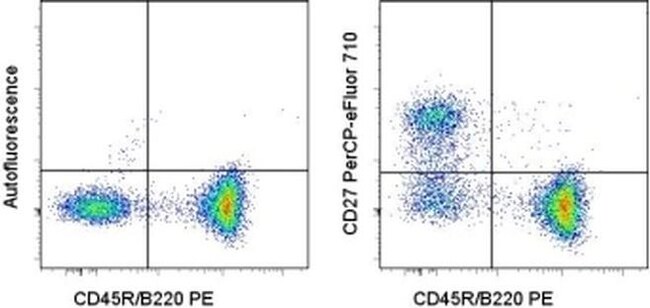
Invitrogen™ CD27 Monoclonal Antibody (LG.7F9), PerCP-eFluor™ 710, eBioscience™, Invitrogen™

Description
Description: The LG.7F9 monoclonal antibody reacts with mouse CD27, a lymphocyte-specific member of the TNFR superfamily. CD27 is expressed by virtually all mature T cells and by a subpopulation of B cells, mainly memory B cells. In mouse, CD27 has been found on nearly all thymocytes excluding a population of CD46-CD8- precursors. CD27 binds to CD70 and, through this interaction, plays an important role in T cell-B cell interaction. It has been reported that triggering CD27 plays an important role in the maturation of CD4+ and CD8+ effector cells. LG.7F9 cross-reacts with human and rat CD27. Applications Reported: This LG.7F9 antibody has been reported for use in flow cytometric analysis. Applications Tested: This LG.7F9 antibody has been tested by flow cytometric analysis of mouse spleen cells. This can be used at less than or equal to 0.06 μg per test. A test is defined as the amount (μg) of antibody that will stain a cell sample in a final volume of 100 μL. Cell number should be determined empirically but can range from 10^5 to 10^8 cells/test. It is recommended that the antibody be carefully titrated for optimal performance in the assay of interest. PerCP-eFluor™ 710 emits at 710 nm and is excited with the blue laser (488 nm); it can be used in place of PerCP-Cyanine5.5. We recommend using a 710/50 bandpass filter, however, the 695/40 bandpass filter is an acceptable alternative.
Specifications
Specifications
| Antigen | CD27 |
| Applications | Flow Cytometry |
| Classification | Monoclonal |
| Clone | LG.7F9 |
| Concentration | 0.2 mg/mL |
| Conjugate | PerCP-eFluor 710 |
| Formulation | PBS with 0.09% sodium azide; pH 7.2 |
| Gene | CD27 |
| Gene Accession No. | P26842, P41272 |
| Gene Alias | CD antigen 27; CD27; CD27 antigen; CD27 molecule; CD27L receptor; LPFS2; S152; S152. LPFS2; sCD27; soluble CD27; T cell activation antigen S152; T14; T-cell activation antigen CD27; TNFRSF7; TNFSF7; Tp55; Tumor necrosis factor receptor superfamily member 7; tumor necrosis factor receptor superfamily, member 7 |
| Show More |
For Research Use Only.