Learn More
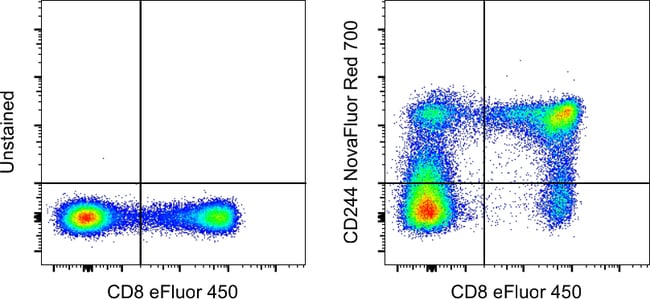

Invitrogen™ CD244 Monoclonal Antibody (eBioC1.7 (C1.7)), NovaFluor™ Red 700, eBioscience™
Description
The eBioC1.7 monoclonal antibody reacts with human CD244 (2B4, p38). In human, CD244 is a 38 kDa protein expressed on NK cells, a subset of CD8+ T cells, gammadelta T cells, monocytes, basophils and eosinophils. Binding of the CD244 ligand, CD48, results in NK cell activation, unlike mouse CD244, which is an inhibitory receptor. For CD244 expressed on NK cells, binding of CD48 results in enhanced NK cell cytotoxicity and secretion of IFN-gamma. Recently, it was demonstrated that binding of the C1.7 monoclonal antibody and CD48 involve the same residue in the V domain of human CD244, which explains the ability of C1.7 binding to induce activation of NK cells. Binding of C1.7 to CD244 leads to tyrosine phosphorylation and recruitment of the adaptor molecule SAP (SLAM-associated protein). Patients with X-linked lymphoproliferative disorder (XLPD) have a mutation in SAP which renders it unable to bind to phosphorylated CD244. This product contains 1 vial of NovaFluor conjugate and 1 vial of CellBlox Plus Blocking Buffer. Applications Tested This eBioC1.7 antibody has been pre-diluted and tested by flow cytometric analysis of normal human peripheral blood cells. This may be used at 5 μL (0.4 μg) per test. A test is defined as the amount (μg) of antibody that will stain a cell sample in a final volume of 100 μL. Cell number should be determined empirically but can range from 10^5 to 10^8 cells/test. Master mixes Master...
Specifications
Specifications
| Antigen | CD244 |
| Applications | Flow Cytometry |
| Classification | Monoclonal |
| Clone | eBioC1.7 (C1.7) |
| Concentration | 0.4 μg/Test |
| Conjugate | NovaFluor Red 700 |
| Formulation | PBS with BSA and 0.09% sodium azide; pH 7.2 |
| Gene | CD244 |
| Gene Accession No. | Q9BZW8 |
| Gene Alias | 2B4; C9.1; CD244; CD244 long isoform; CD244 molecule; Cd244 molecule, natural killer cell receptor 2B4; CD244 natural killer cell receptor 2B4; CD244 short isoform; F730046O15Rik; h2B4; Ly90; NAIL; natural killer cell receptor 2B4; NK cell activation inducing ligand NAIL; NK cell activation-inducing ligand; NK cell receptor 2B4; NK cell type I receptor protein 2B4; NKR Nmrk; NKR2B4; Nmrk; non MHC restricted killing associated; non-MHC restricted killing associated; Signaling lymphocytic activation molecule 4; SLAM family member 4; SLAMF4; transmembrane NK cell receptor 2B4 |
| Show More |