Learn More
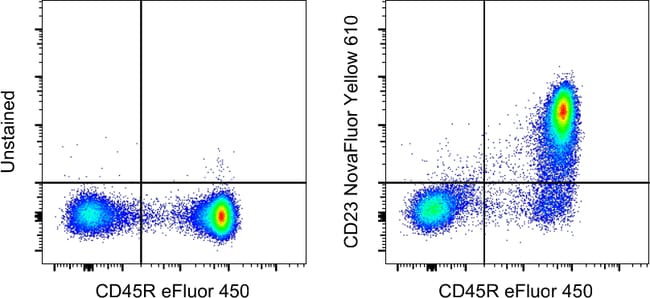
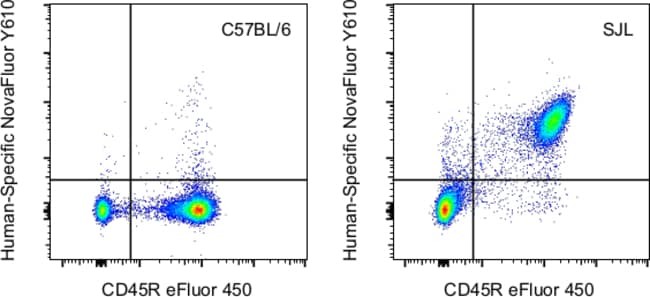

Invitrogen™ CD23 Monoclonal Antibody (B3B4), NovaFluor™ Yellow 610, eBioscience™
Description
Description: The B3B4 monoclonal antibody reacts with mouse CD23, a 45 kDa type II transmembrane glycoprotein. CD23 is expressed on resting conventional B cells, and its expression is modulated upon B-cell activation. B-1 cell lineage (CD5+ B cells) does not express CD23. Soluble forms of the antigen have been reported to be biologically active. CD23 is a low affinity receptor for IgE and is thought to play a role in the regulation of IgE response and B-cell activation. CD21 is thought to bind to CD23. This product contains 1 vial of NovaFluor conjugate and 1 vial of CellBlox Plus Blocking Buffer. Applications Tested: This eBio4KB128 antibody has been tested by flow cytometric analysis of mouse splenocytes. This may be used at less than or equal to 0.4 μg per test. A test is defined as the amount (μg) of antibody that will stain a cell sample in a final volume of 100 μL. Cell number should be determined empirically but can range from 10^5 to 10^8 cells/test. It is recommended that the antibody be carefully titrated for optimal performance in the assay of interest Master mixes.
Specifications
Specifications
| Antigen | CD23 |
| Applications | Flow Cytometry |
| Classification | Monoclonal |
| Clone | B3B4 |
| Concentration | 0.1 mg/mL |
| Conjugate | NovaFluor Yellow 610 |
| Formulation | PBS with BSA and 0.09% sodium azide; pH 7.2 |
| Gene | Fcer2a |
| Gene Accession No. | P20693 |
| Gene Alias | BLAST-2; CD23; CD23 antigen; CD23A; CLEC4J; C-type lectin domain family 4 member J; C-type lectin domain family 4, member J; Fc epsilon receptor II; FC epsilon RII; Fc fragment of IgE receptor II; Fc fragment of IgE, low affinity II, receptor for (CD23); Fc receptor alpha multiple ligand receptor; Fc receptor, IgE, low affinity II, alpha polypeptide; Fcalpha muR; Fcalpha RII; Fce2; fc-epsilon-RII; FCER2; Fcer2a; FceRII; IGEBF; Immunoglobulin E-binding factor; immunoglobulin epsilon-chain; low affinity immunoglobulin epsilon Fc receptor; Low affinity immunoglobulin epsilon Fc receptor membrane-bound form; Low affinity immunoglobulin epsilon Fc receptor soluble form; low-affinity IgE receptor; Ly-42; lymphocyte IgE receptor |
| Show More |