Learn More
Invitrogen™ CD1c Monoclonal Antibody (L161), Alexa Fluor™ 647, eBioscience™
Description
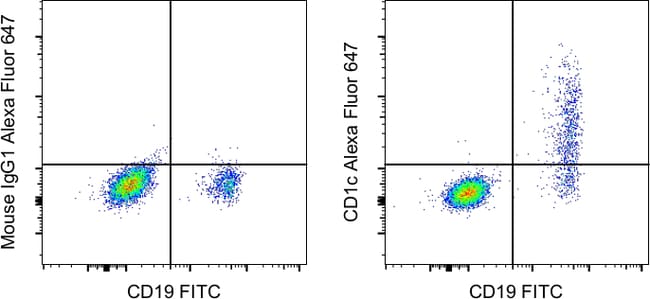
This L161 monoclonal antibody detects CD1c (also known as BDCA-1), a glycoprotein that is noncovalently linked to beta-2 microglobulin on thymocytes and antigen presenting cells such as dendritic and Langerhans cells. This molecule is also expressed on some circulating and marginal zone B cells, as well as in lymph nodes and germinal centers. CD1c is involved in the presentation of lipid antigens such as microbial fatty acids to effector T cells during the adaptive immune response. Finally, alternative splicing gives rise to three different isoforms of CD1c (soluble, membrane, and cytoplasmic/soluble isoforms). Applications Reported: This L161 antibody has been reported for use in flow cytometric analysis. Applications Tested: This L161 antibody has been pre-diluted and tested by flow cytometric analysis of normal human peripheral blood cells. This may be used at 5 μL (0.125 μg) per test. A test is defined as the amount (μg) of antibody that will stain a cell sample in a final volume of 100 μL. Cell number should be determined empirically but can range from 10^5 to 10^8 cells/test. Excitation: 633-647 nm; Emission: 668 nm; Laser: Red Laser.
Specifications
Specifications
| Antigen | CD1c |
| Applications | Flow Cytometry |
| Classification | Monoclonal |
| Clone | L161 |
| Concentration | 5 μL/Test |
| Conjugate | Alexa Fluor 647 |
| Formulation | PBS with BSA and 0.09% sodium azide; pH 7.2 |
| Gene | CD1C |
| Gene Accession No. | P29017 |
| Gene Alias | BDCA1; canCD1c; CD1; CD1A; CD1C; CD1C antigen, c polypeptide; CD1c molecule; cortical thymocyte antigen CD1C; differentiation antigen CD1-alpha-3; R7; RP11-101J8.3; T-cell surface glycoprotein CD1c |
| Show More |