missing translation for 'onlineSavingsMsg'
Learn More
Learn More
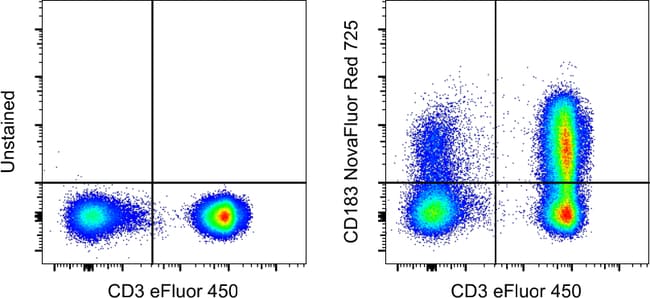

Invitrogen™ CD183 (CXCR3) Monoclonal Antibody (CEW33D), NovaFluor™ Red 725, eBioscience™
Mouse Monoclonal Antibody
Supplier: Invitrogen™ H087T02R05A
Description
Description: The CEW33D monoclonal antibody reacts with human CD183. CD183, also known as CXCR3, is a G protein-coupled chemokine receptor that interacts with ligands CXCL9 (MIG), CXCL10 (IP-10), and CXCL11 (I-TAC). This product contains 1 vial of NovaFluor conjugate and 1 vial of CellBlox Plus Blocking Buffer. Applications Tested: This CEW33D antibody has been pre-titrated and tested by flow cytometric analysis of normal human peripheral blood cells. This can be used at 5 μL (0.8 μg) per test. A test is defined as the amount (μg) of antibody that will stain a cell sample in a final volume of 100 μL. Cell number should be determined empirically but can range from 10^5 to 10^8 cells/test Master mixes. Whole Blood compatibility: When utilizing whole blood (as opposed to density-gradient-purified PBMC), we recommend lysing red blood cells in bulk prior to staining with NovaFluor conjugates.
CD183, also known as CXCR3, is a seven-transmembrane G protein-coupled chemokine receptor that binds CXCL9 (Mig), CXCL10 (IP-10), and CXCL11 (I-TAC), which are part of the CXC chemokine subfamily. CD183 plays a crucial role in leukocyte traffic, influencing integrin activation, cytoskeletal changes, and chemotactic migration. It is expressed on NK cells, subsets of T lymphocytes, regulatory T cells (Tregs), and is preferentially found on Th1-polarized cells. CD183 is prominently expressed in effector/memory T cells and T cells in inflamed tissues, contributing to CD4 T cell responses to grafts, as evidenced by compromised allograft rejection in CXCR3 knockout mice. Chemokine binding induces rapid, short-lived cellular responses due to receptor internalization, with responsiveness restored after receptor recycling. Inhibition by Bordetella pertussis toxin suggests coupling with Gi subclass G proteins. The production of IP-10, Mig, and I-TAC in inflammatory lesions indicates CD183 role in recruiting inflammatory cells, making it a target for developing antagonists to treat inflammatory diseases. Multiple transcript variants encoding different isoforms of CD183 have been identified.Specifications
| CD183 (CXCR3) | |
| Monoclonal | |
| 0.8 μg/Test | |
| PBS with BSA and 0.09% sodium azide; pH 7.2 | |
| P49682 | |
| CXCR3 | |
| Affinity chromatography | |
| RUO | |
| 2833 | |
| 4°C, store in dark, DO NOT FREEZE! | |
| Liquid |
| Flow Cytometry | |
| CEW33D | |
| NovaFluor Red 725 | |
| CXCR3 | |
| an; C Cmotif chemokine; C X C motif chemokine; CC motif chemokine; CCmotif chemokine; CD182; CD183; chemokine (C-X-C motif) receptor 3; chemokine receptor 3; CKR-L2; Cmkar3; CXC; C-X-C chemokine receptor type 3; CXC motif chemokine; C-X-C motif chemokine receptor 3; Cxcr3; CXC-R3; CXCR-3; G protein-coupled receptor 9; GPR9; Interferon-inducible protein 10 receptor; IP10; IP10 receptor; IP-10 receptor; IP10-R; Mig receptor; MigR; Mig-R | |
| Mouse | |
| 25 Tests | |
| Primary | |
| Human | |
| Antibody | |
| IgG1 κ |