missing translation for 'onlineSavingsMsg'
Learn More
Learn More
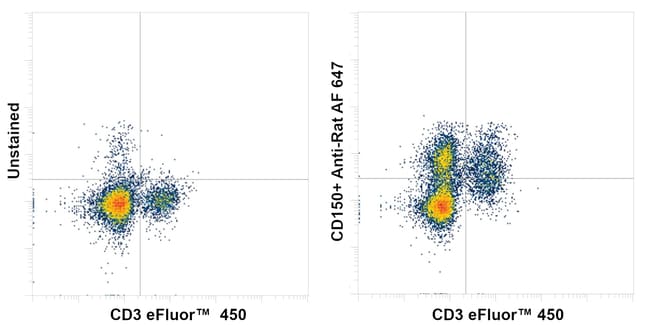
Invitrogen™ CD150 Recombinant Rat Monoclonal Antibody (mShad150)
Rat Recombinant Monoclonal Antibody
$607.04 - $960.35
Specifications
| Antigen | CD150 |
|---|---|
| Clone | mShad150 |
| Concentration | 1 mg/mL |
| Content And Storage | -20°C, Avoid Freeze/Thaw Cycles |
| Applications | Flow Cytometry |
Description
This is an engineered recombinant antibody that was developed to provide superior sensitivity without changing the paratope. Recombinant antibodies are produced using specific genes that code for the desired antibodies. These genes are cloned into an expression vector and expressed in vitro. The advantages of recombinant antibodies include better specificity, lot-to-lot consistency and improved signal-to-noise ratio. It is recommended that the antibody be carefully titrated for optimal performance in the assay of interest.
CD150, also known as SLAM (Signaling Lymphocyte Activation Molecule), is a member of the immunoglobulin gene superfamily and plays a crucial role in T cell stimulation and immune cell interactions. It is constitutively expressed on peripheral blood memory T cells, T cell clones, immature thymocytes, and a proportion of B cells. CD150 expression is rapidly upregulated upon activation, particularly on naive T cells, Th1 cells, and activated B cells, which express the membrane-bound, soluble, and cytoplasmic isoforms of SLAM. In T cells, signaling through SLAM induces proliferation and enhances the interferon-gamma response. SLAM is also involved in adhesion between T cells and antigen-presenting cells, facilitating immune cell interactions. Homophilic SLAM-SLAM binding during B to B and B to T cell interactions is suggested to enhance the expansion and differentiation of activated B cells. CD150 serves as a receptor for the measles virus and acts as a co-activator on T and B cells. It interacts with SH2D1A and PTPN11 via its cytoplasmic domain, playing a role in signal transduction. Mutations in the CD150 gene may be associated with X-linked lymphoproliferative disease (XLP), highlighting its importance in immune regulation and disease pathology.Specifications
| CD150 | |
| 1 mg/mL | |
| Flow Cytometry | |
| Unconjugated | |
| Rat | |
| RUO | |
| PBS with 0.09% sodium azide; pH 7.4 | |
| Q9QUM4 | |
| 27218 | |
| Primary | |
| Affinity chromatography |
| mShad150 | |
| -20°C, Avoid Freeze/Thaw Cycles | |
| Recombinant Monoclonal | |
| Liquid | |
| IgG2b λ | |
| Mouse | |
| Slamf1 | |
| 4933415F16; AA177906; CD150; CD150 antigen; CDw150; ESTM51; IPO-3; RGD1560634; signaling lymphocyte activation molecule; signaling lymphocytic activation molecule; signaling lymphocytic activation molecule family member 1; Slam; SLAM family member 1; Slamf1 | |
| Slamf1 | |
| Antibody |