Learn More
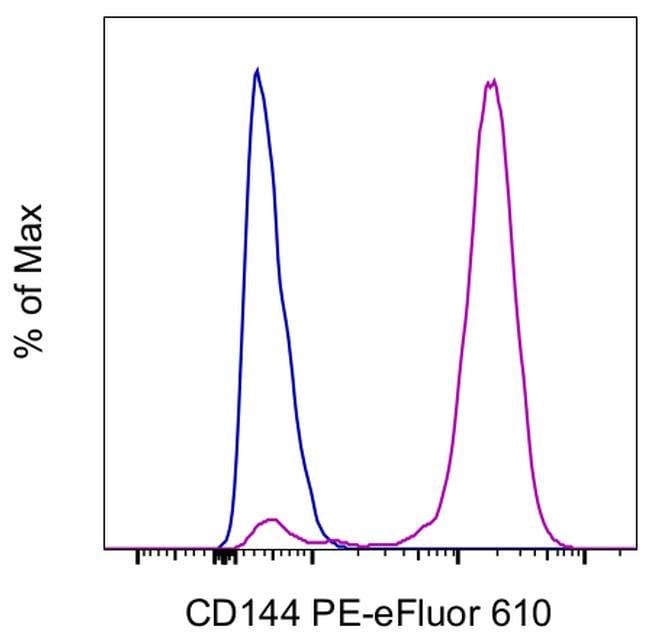
Invitrogen™ CD144 (VE-cadherin) Monoclonal Antibody (16B1), PE-eFluor™ 610, eBioscience™
Description
The 16B1 antibody reacts with human CD144, also known as VE-cadherin and cadherin-5. The cadherin family of receptors, which are calcium-dependent adhesion molecules, is known to be involved in homophilic cell interactions. VE-cadherin, which is 140 kDa, is localized at the intercellular boundaries of endothelial cells in blood and lymphatic vessels in several tissues. It is thought to play a role in vascular permeability and remodeling. Applications Reported: This 16B1 antibody has been reported for use in flow cytometric analysis. Applications Tested: This 16B1 antibody has been pre-diluted and tested by flow cytometric analysis of Human Umbilical Vein Endothelial Cells (HUVEC). This may be used at 5 μL (0.25 μg) per test. A test is defined as the amount (μg) of antibody that will stain a cell sample in a final volume of 100 μL. Cell number should be determined empirically but can range from 10^5 to 10^8 cells/test. PE-eFluor 610 can be excited with laser lines from 488-561 nm and emits at 607 nm. We recommend using a 610/20 band pass filter (equivalent to PE-Texas Red). Please make sure that your instrument is capable of detecting this fluorochrome. Light sensitivity: This tandem dye is sensitive to photo-induced oxidation. Please protect this vial and stained samples from light. Fixation: Samples can be stored in IC Fixation Buffer (Product # 00-8222-49) (100 μL of cell sample + 100 μL of IC Fixation Buffer) or 1-step Fix/Lyse Solution (P...
Specifications
Specifications
| Antigen | CD144 (VE-cadherin) |
| Applications | Flow Cytometry |
| Classification | Monoclonal |
| Clone | 16B1 |
| Concentration | 5 μL/Test |
| Conjugate | PE-eFluor 610 |
| Formulation | PBS with BSA and 0.09% sodium azide; pH 7.2 |
| Gene | CDH5 |
| Gene Accession No. | P33151 |
| Gene Alias | 7B4; 7B4 antigen; 7B4/cadherin-5; AA408225; cadherin 5; cadherin 5, type 2 (vascular endothelium); cadherin 5, type 2, VE-cadherin (vascular endothelium); cadherin 5, type 2, VE-cadherin (vascular epithelium); cadherin-5; cadherin-5; cd144 antigen; VE cadherin; Cd144; cd144 antigen; CDH5; cell-cell adhesion protein; endothelial-specific cadherin; vascular endothelial cadherin; vascular endothelial cadherin precursor; Vec; VEcad; VE-Cad; VE-cadherin; VECD |
| Show More |