Learn More
Invitrogen™ CD14 Monoclonal Antibody (61D3), PerCP-eFluor™ 710, eBioscience™, Invitrogen™
Description
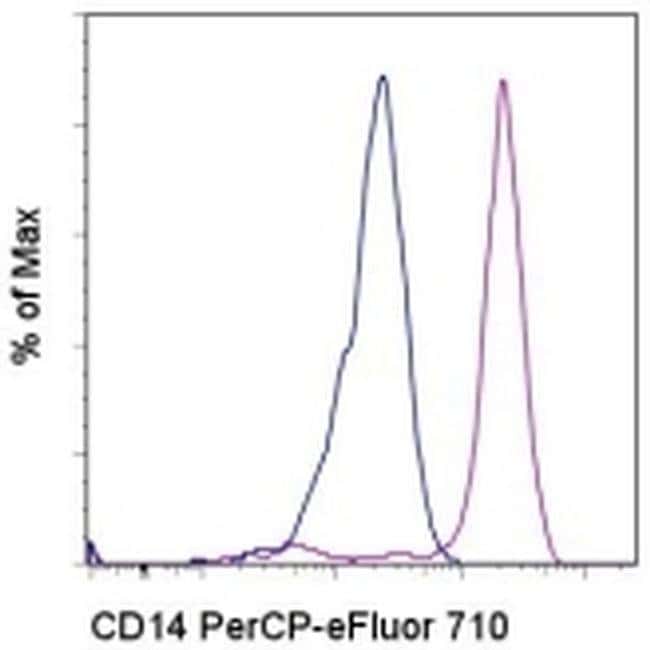
Description: The 61D3 monoclonal antibody reacts with human CD14, a 53-55 kDa GPI-linked glycoprotein. CD14 is expressed on monocytes, interfollicular macrophages and some dendritic cells. Complexes of LPS and LBP (LPS-Binding Protein) bind with high affinity to monocytes through the surface CD14. Applications Reported: This 61D3 antibody has been reported for use in flow cytometric analysis. Applications Tested: This 61D3 antibody has been pre-titrated and tested by flow cytometric analysis of normal human peripheral blood cells. This can be used at 5 μL (0.125 μg) per test. A test is defined as the amount (μg) of antibody that will stain a cell sample in a final volume of 100 μL. Cell number should be determined empirically but can range from 10^5 to 10^8 cells/test. PerCP-eFluor™ 710 emits at 710 nm and is excited with the blue laser (488 nm); it can be used in place of PerCP-Cyanine5.5. We recommend using a 710/50 bandpass filter, however, the 695/40 bandpass filter is an acceptable alternative. Please make sure that your instrument is capable of detecting this fluorochrome. Light sensitivity: This tandem dye is sensitive to photo-induced oxidation. Please protect this vial and stained samples from light. Fixation: Samples can be stored in IC Fixation Buffer (cat. 00-8222) (100 μL of cell sample + 100 μL of IC Fixation Buffer) or 1-step Fix/Lyse Solution (cat.
Specifications
Specifications
| Antigen | CD14 |
| Applications | Flow Cytometry |
| Classification | Monoclonal |
| Clone | 61D3 |
| Concentration | 5 μL/Test |
| Conjugate | PerCP-eFluor 710 |
| Formulation | PBS with BSA and 0.09% sodium azide; pH 7.2 |
| Gene | Cd14 |
| Gene Accession No. | P08571 |
| Gene Alias | CD 14; CD14; CD14 antigen; CD14 molecule; cd14 monocyte; lipopolysaccharide receptor; lipoprotein receptor; LPSR antibody; monocyte differentiation antigen CD14; Monocyte differentiation antigen CD14, membrane-bound form; Monocyte differentiation antigen CD14, urinary form; monocyte differentiation antigen CD14; LOW QUALITY PROTEIN: monocyte differentiation antigen CD14; myeloid cell-specific leucine-rich glycoprotein; myeloid membrane glycoprotein precursor; sCD14; soluble CD14 |
| Show More |
For Research Use Only.