missing translation for 'onlineSavingsMsg'
Learn More
Learn More
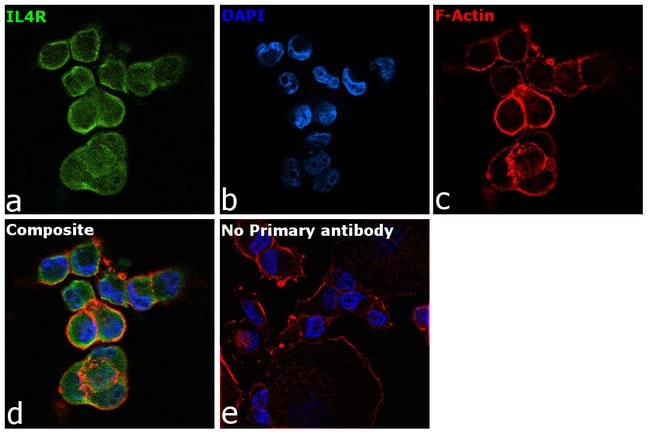
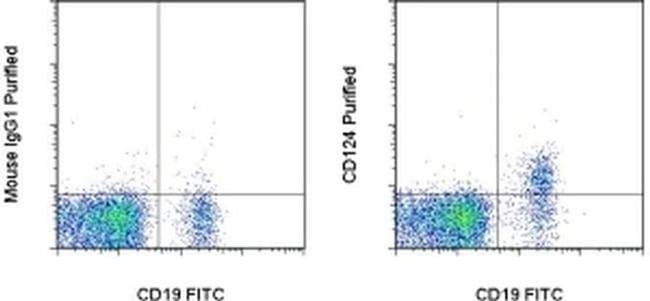
Invitrogen™ CD124 Monoclonal Antibody (X2/45-12), eBioscience™
Mouse Monoclonal Antibody
Supplier: Invitrogen™ 14124982
Description
Description: The monoclonal antibody X2/45-12 reacts with human CD124, which is also known as the IL-4R alpha chain. CD124 can associate with the common gamma chain to form the type I IL-4R or with IL-13Ralpha1 to form the type II IL-4R. While both receptor types can bind IL-4, only the type II receptor can associate with IL-13. The type I IL-4 receptor is found on T, B, NK, mast cells, basophils, and macrophages. The type II IL-4 receptor is found on many non-hematopoietic cells and macrophages. CD124 contains an ITIM that associates with and activates STAT6. IL-4 is responsible for the generation of high-affinity IgE antibodies and driving the polarization of naive Th0 cells into Th2 cells. In mucosal barriers, the cytokine is involved in the recruitment of innate and adaptive immune effector cells and mucous overproduction. Finally, IL-4R also exists as a soluble form that serves primarily as a carrier protein for IL-4 that increases its half-life. The X2/45 antibody has been reported to have antagonist activity. Applications Reported: This X2/45-12 antibody has been reported for use in flow cytometric analysis, and western blotting. (Please use Functional Grade purified X2/45-12, Product # 16-1249-82, in functional assays). Applications Tested: This X2/45-12 antibody has been tested by flow cytometric analysis of normal human peripheral blood cells. This can be used at less than or equal to 1 μg per test. A test is defined as the amount (μg) of antibody that will...
IL4 Receptor alpha (IL4RA) is the alpha chain of the interleukin 4 receptor which binds to both interleukin 4 and interleukin 13 to regulate IgE production, chemokine and mucus production at sites of allergic inflammmation. The IL4 response is involved in promoting Th2 differentiation. The secreted extracellular domain of IL4R alpha, called sIL4R alpha, can inhibit IL4-mediated cell proliferation and IL5 upregulation by T-cells. It has no signaling abilities. Allelic variations in the IL4RA gene have been associated with atopy, a condition that can manifest itself as allergic rhinitis, sinusitus, asthma, or eczema.Specifications
| CD124 | |
| Monoclonal | |
| 0.5 mg/mL | |
| PBS with 0.09% sodium azide; pH 7.2 | |
| P24394 | |
| IL4R | |
| Affinity chromatography | |
| RUO | |
| 3566 | |
| 4°C | |
| Liquid |
| Flow Cytometry, Functional Assay, Western Blot, Immunocytochemistry | |
| X2/45-12 | |
| Unconjugated | |
| IL4R | |
| 582J2.1; CD124; il-4 receptor; IL-4 receptor alpha chain; IL-4 receptor subunit alpha; IL-4-binding protein; IL4-BP; Il4r; IL4R nirs variant 1; IL-4R subunit alpha; IL4RA; IL-4RA; IL-4R-alpha; interleukin 4 receptor; interleukin 4 receptor, alpha; interleukin-4 receptor alpha chain; interleukin-4 receptor subunit alpha; Soluble IL-4 receptor subunit alpha; Soluble interleukin-4 receptor subunit alpha | |
| Mouse | |
| 100 μg | |
| Primary | |
| Human | |
| Antibody | |
| IgG1 κ |