Learn More
Invitrogen™ CD11b/c Monoclonal Antibody (OX42), eFluor™ 660, eBioscience™

Description
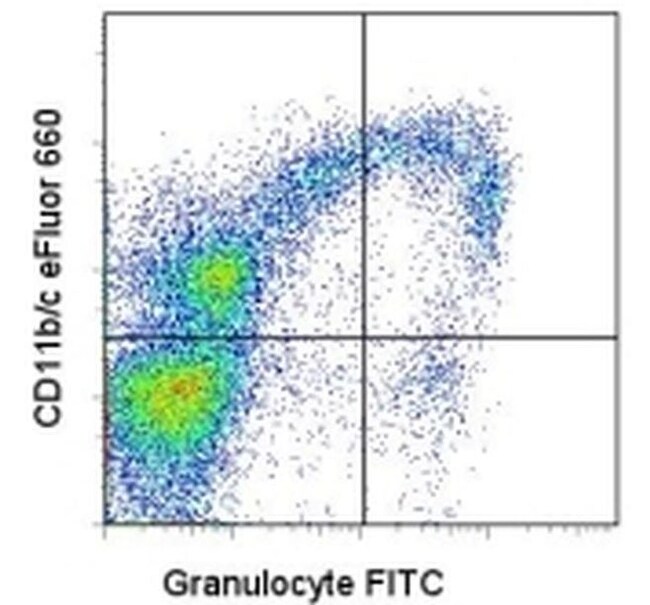
Description: This OX42 monoclonal antibody reacts with rat CD11b and CD11c. CD11b, also known as integrin alpha M or Mac-1, is a component of complement receptor 3 (CR3). CD11c, also known as integrin alpha X, is a component of complement receptor 4 (CR4). CD11b and CD11c are expressed on immune cells such as macrophages, monocytes, granulocytes, and dendritic cells. OX42 has also been shown to detect microglia in the brain, as well as cells of the liver and epidermis. The OX42 antibody has been reported to inhibit complement-mediated rosette formation by granulocytes and macrophages. Moreover, studies demonstrate that OX42 can inhibit granulocyte aggregation. Applications Reported: This OX42 antibody has been reported for use in flow cytometric analysis. Applications Tested: This OX42 antibody has been tested by flow cytometric analysis of rat splenocytes. This can be used at less than or equal to 0.125 μg per test. A test is defined as the amount (μg) of antibody that will stain a cell sample in a final volume of 100 μL. Cell number should be determined empirically but can range from 10^5 to 10^8 cells/test. It is recommended that the antibody be carefully titrated for optimal performance in the assay of interest. eFluor® 660 is a replacement for Alexa Fluor® 647. eFluor® 660 emits at 659 nm and is excited with the red laser (633 nm). Please make sure that your instrument is capable of detecting this fluorochome. Excitation: 633-647 nm; Emission: 668...
Specifications
Specifications
| Antigen | CD11b/c |
| Applications | Flow Cytometry |
| Classification | Monoclonal |
| Clone | OX42 |
| Concentration | 0.2 mg/mL |
| Conjugate | eFluor 660 |
| Formulation | PBS with 0.09% sodium azide; pH 7.2 |
| Gene | Itgam |
| Gene Accession No. | 0 |
| Gene Alias | AI449405; antigen CD11b (p170); CD11 antigen-like family member B; CD11 antigen-like family member C; CD11b; CD11B (p170); CD11b/CD18; CD11bc; CD11C; CD11C (p150) alpha polypeptide; cell surface glycoprotein MAC-1 alpha subunit; cell surface glycoprotein MAC-1 subunit alpha; complement component 3 receptor 3 subunit; complement component 3 receptor 4 subunit; complement component receptor 3 alpha-a; complement receptor 4; complement receptor type 3; CR3; CR-3 alpha chain; CR3A; Cr4; F730045J24Rik; integrin alpha M; integrin alpha X; integrin alpha-M; Integrin alpha-X; integrin aX; integrin subunit alpha M; integrin subunit alpha X; integrin, alpha M; integrin, alpha M (complement component 3 receptor 3 subunit); integrin, alpha X; integrin, alpha X (antigen CD11C (p150), alpha polypeptide); integrin, alpha X (complement component 3 receptor 4 subunit); ITGAM; ITGAX; Leu M5; leu M5, alpha subunit; leukocyte adhesion glycoprotein p150,95 alpha chain; Leukocyte adhesion receptor MO1; leukocyte adhesion receptor p150,95; leukocyte surface antigen p150,95, alpha subunit; Ly-40; MAC1; MAC-1; Mac-1 alpha; MAC1A; Mac-1a; macrophage antigen alpha; macrophage antigen alpha polypeptide; MGC117044; MO1A; myeloid membrane antigen, alpha subunit; N418; Neutrophil adherence receptor; neutrophil adherence receptor alpha-M subunit; OX42; OX-42; p150 95 integrin alpha chain; RGD1561123; SLEB6 |
| Show More |