missing translation for 'onlineSavingsMsg'
Learn More
Learn More

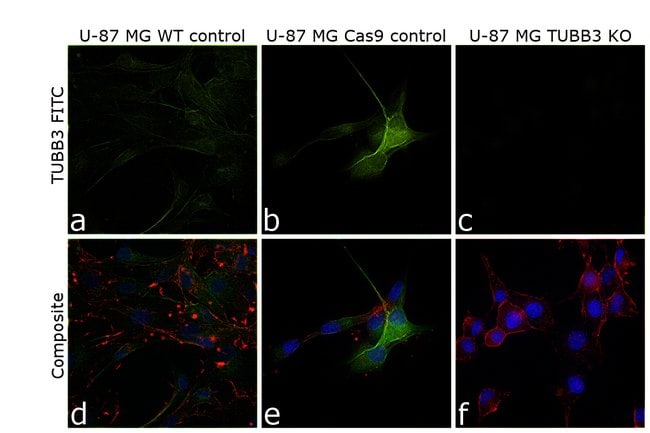
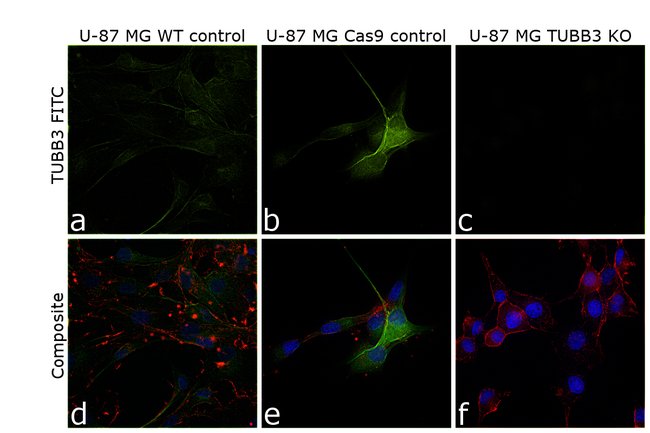
beta-3 Tubulin Monoclonal Antibody (2G10-TB3), Alexa Fluor™ 488, eBioscience™, Invitrogen™
Mouse Monoclonal Antibody
$259.00 - $628.00
Specifications
| Antigen | beta-3 Tubulin |
|---|---|
| Clone | 2G10-TB3 |
| Concentration | 0.5 mg/mL |
| Applications | Immunohistochemistry (Frozen), Immunohistochemistry (Paraffin), Immunocytochemistry |
| Classification | Monoclonal |
Description
Description: The 2G10 monoclonal antibody recognizes beta tubulin class III, a member of the large family of tubulins that are components of the microtubules of the cytoskeletal network. Beta tubulin class III expression is exclusively found in neuronal cells of adult mammals. Although expression has been mainly found in neuronal cells, during fetal development, transient expression has been documented in both glial and neuronal precursors localized to the subventricular zone. Identification of beta tubulin class III expression is useful as a structural marker for developing and mature neural cells. Given the high degree of conservation of this protein across species, the 2G10 clone is expected to recognize human, mouse, rat, and bovine beta tubulin class III. Applications Reported: This 2G10-TB3 antibody has been reported for use in immunohistochemical staining of frozen tissue sections, immunohistochemical staining of formalin-fixed paraffin embedded tissue sections, microscopy, and immunocytochemistry. Applications Tested: This 2G10-TB3 antibody has been tested by immunocytochemistry of formaldehyde-fixed and permeabilized cells and can be used at less than or equal to 10 μg/mL. It is recommended that the antibody be carefully titrated for optimal performance in the assay of interest. Excitation: 488 nm; Emission: 519 nm; Laser: Blue Laser. Filtration: 0.2 μm post-manufacturing filtered.
The betaIII-tubulin isoform is present dominantly in cells of neuronal origin and it is one of the earliest markers of neuronal differentiation. It is regarded as a specific probe for the cells of neuronal origin as well as for the tumours originating from these cells. The betaIII-tubulin is most abundant in cells of neuronal origin, but was also detected in Sertoli cells of the testis and transiently in non-neuronal embryonic tissues.Specifications
| beta-3 Tubulin | |
| 0.5 mg/mL | |
| Monoclonal | |
| Liquid | |
| RUO | |
| PBS with 0.09% sodium azide; pH 7.2 | |
| 3200002H15Rik; beta 3 tubulin; beta tubulin 3; beta-4; betaIII-tubulin; CDCBM; CDCBM1; CFEOM3; CFEOM3A; class III beta-tubulin; FEOM3; I79_000194; LOC100341581; M(beta)3; M(beta)6; mc1R; melanocortin receptor 1; Neuron specific beta III Tubulin; neuron-specific class III beta-tubulin; TUBB; Tubb3; TUBB4; tubulin beta; tubulin beta 3 class III; Tubulin beta-3; tubulin beta-3 chain; Tubulin beta-4; Tubulin beta-4 chain; tubulin beta-III; tubulin, beta 3 class III; tubulin, beta, 3; tubulin, beta, 4; Unknown (protein for MGC:134115) | |
| TUBB3 | |
| Primary | |
| 4°C, store in dark, DO NOT FREEZE! | |
| TUBB3 |
| 2G10-TB3 | |
| Immunohistochemistry (Frozen), Immunohistochemistry (Paraffin), Immunocytochemistry | |
| Alexa Fluor 488 | |
| Mouse | |
| Bovine, Human, Mouse, Rat | |
| Q13509, Q2T9S0, Q4QRB4, Q9ERD7 | |
| 10381, 22152, 246118, 768070 | |
| IgG2a κ | |
| Affinity chromatography | |
| Antibody |
For Research Use Only.