missing translation for 'onlineSavingsMsg'
Learn More
Learn More
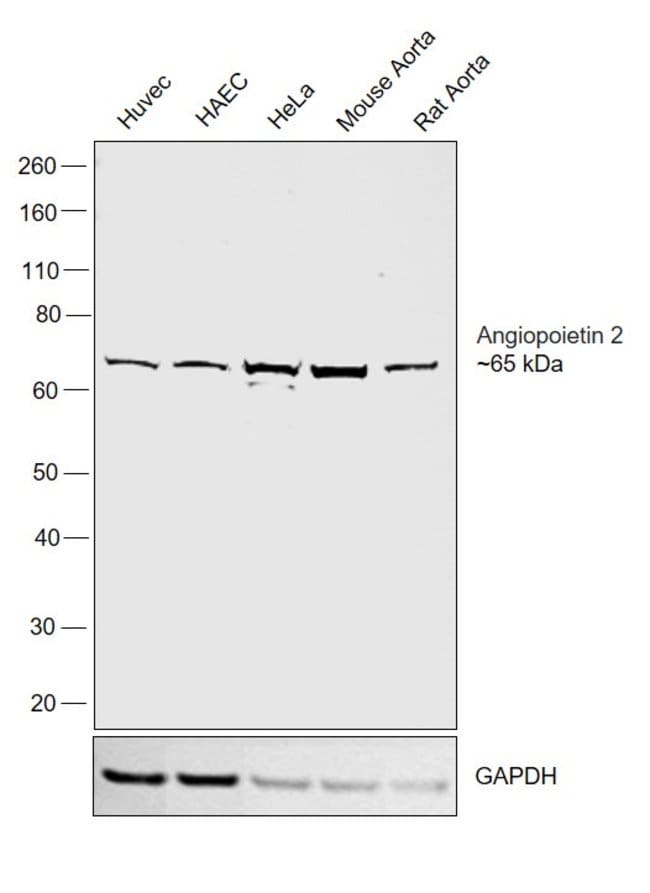
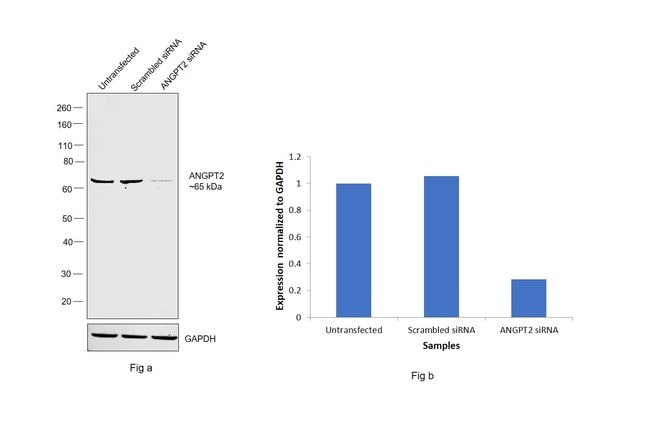
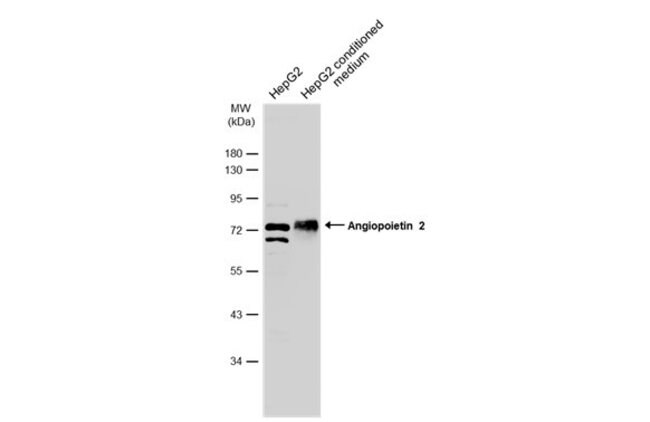
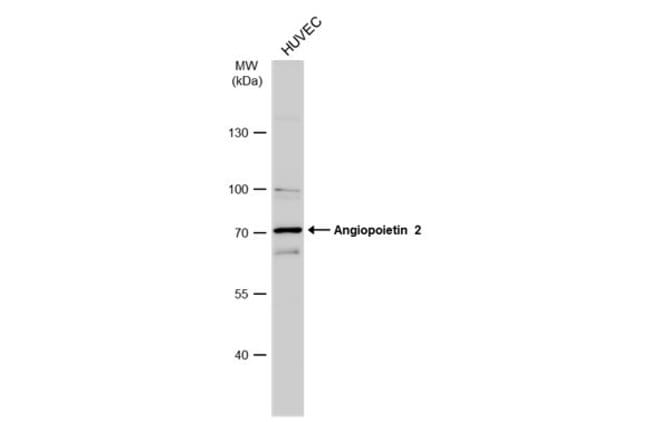
Invitrogen™ Angiopoietin 2 Polyclonal Antibody

Description
Recommended positive controls: HUVEC. Predicted reactivity: Mouse (84%), Rat (86%), Dog (92%), Pig (92%), Chicken (85%), Bovine (89%). Store product as a concentrated solution. Centrifuge briefly prior to opening the vial.
ANG-2 binds to the endothelial cell specific receptor Tie-2, but, in contrast to ANG-1, does not induce tyrosine phosphorylation. Consequently, ANG-2 modulates ANG-1 activation of Tie-2 and, depending on the physiological and biochemical environment, can act either as an agonist or antagonist of Tie-2 induced angiogenesis. The signaling interactions of ANG-1, ANG-2 and Tie-2, along with less characterized ANG-3 and ANG-4, are required for embryonic and adult angiogenesis. Physiologically, ANG-1 and ANG-2 are associated with sprouting, tube formation, and structural integrity of newly formed blood vessels. Mature human ANG-2 is a secreted protein containing 480 amino acid residues. ANG-2 is composed of an alpha-helix-rich coiled coil N-terminal domain and fibrinogen-like C-terminal domain. ANG-2 exists predominantly in the form of a disulfide-linked dimer.
Specifications
Specifications
| Antigen | Angiopoietin 2 |
| Applications | Western Blot |
| Classification | Polyclonal |
| Concentration | 1 mg/mL |
| Conjugate | Unconjugated |
| Formulation | PBS with 20% glycerol and 0.025% ProClin 300; pH 7 |
| Gene | ANGPT2 |
| Gene Accession No. | O15123, O35462 |
| Gene Alias | AGPT2; Ang2; Ang-2; angiopoietin 2; angiopoietin-2; angiopoietin-2a; angiopoietin-2B; ANGPT2; endothelial growth factor; Tie2-ligand |
| Gene Symbols | ANGPT2 |
| Show More |