missing translation for 'onlineSavingsMsg'
Learn More
Learn More
Invitrogen™ alpha-Fetoprotein Monoclonal Antibody (AFP3), Alexa Fluor™ 488, eBioscience™

Mouse Monoclonal Antibody
Specifications
| Antigen | alpha-Fetoprotein |
|---|---|
| Clone | AFP3 |
| Concentration | 0.5 mg/mL |
| Content And Storage | 4°C, store in dark, DO NOT FREEZE! |
| Applications | Immunocytochemistry |
Description
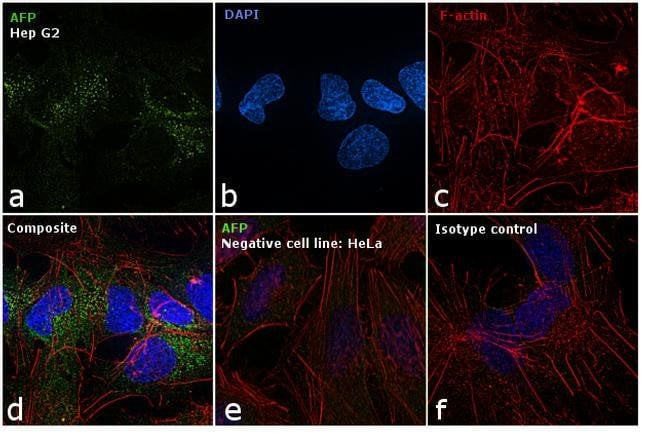
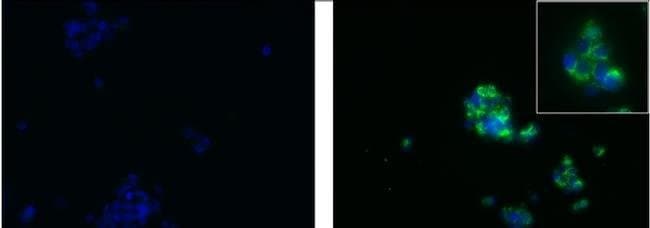
Description: This AFP3 monoclonal antibody reacts with human alpha-fetoprotein (AFP). This 70-kDa secretory protein is a member of the albumin gene family. Synthesized by the yolk sac and fetal liver during embryogenesis, AFP protein levels are highest in fetal serum. After birth, serum AFP levels decrease dramatically. In fact, AFP is nearly undetectable in normal adult serum. However, hepatocellular carcinoma and germ cell teratoblastoma, as well as liver regeneration, viral hepatitis, and cirrhosis, leads to elevated AFP serum levels in adults. As such, detection of this protein is frequently used as a diagnostic marker for these conditions. When performing western blotting or immunohistochemistry on paraffin section, we recommend the use of monoclonal antibody 1E8 (Product # 14-9499). Applications Reported: This AFP3 antibody has been reported for use in immunocytochemistry. Applications Tested: This AFP3 antibody has been tested by immunofluorescent staining of formaldehyde-fixed and permeabilized HepG2 cells. This can be used at less than or equal to 10 μg/mL. It is recommended that the antibody be titrated for optimal performance in the assay of interest. Excitation: 488 nm; Emission: 519 nm; Laser: Blue Laser. Filtration: 0.2 μm post-manufacturing filtered.
AFP (Alpha Fetoprotein) is a major plasma protein produced by the yolk sac, intestinal tract and the liver during fetal life. AFP expression in adults is often associated with hepatoma or teratoma. However, hereditary persistence of AFP may also be found in individuals with no obvious pathology. The protein is thought to be the fetal counterpart of serum albumin, and AFP and albumin genes are present in tandem in the same transcriptional orientation on chromosome 4. AFP is found in monomeric, dimeric, and trimeric forms. AFP can also bind to copper ions, nickel ions, fatty acids and bilirubin. The level of AFP in amniotic fluid is used to measure renal loss of protein to screen for spina bifida and anencephaly. High level of serum AFP has been identified in patients with hepatocellular carcinomas (HCC), teratoblastoma, colorectal cancer, pancreatic cancer, and germ cell neoplasms.Specifications
| alpha-Fetoprotein | |
| 0.5 mg/mL | |
| Immunocytochemistry | |
| Alexa Fluor 488 | |
| Mouse | |
| RUO | |
| PBS with 0.09% sodium azide; pH 7.2 | |
| P02771 | |
| 174 | |
| Primary | |
| Affinity chromatography |
| AFP3 | |
| 4°C, store in dark, DO NOT FREEZE! | |
| Monoclonal | |
| Liquid | |
| IgG1 κ | |
| Human | |
| AFP | |
| a fetoglobulin; a fetoprotein; Afp; AFPD; Alpha fetoglobulin; alpha fetoprotein; alpha-1-fetoprotein; Alpha-fetoglobulin; alpha-fetoprotein; alpha-fetoprotein precursor; alpha-foetoprotein; chloride intracellular channel 6; FETA; fetoglobulin; fetoprotein; HPAFP; a fetoglobulin; a fetoprotein | |
| AFP | |
| Antibody |