missing translation for 'onlineSavingsMsg'
Learn More
Learn More
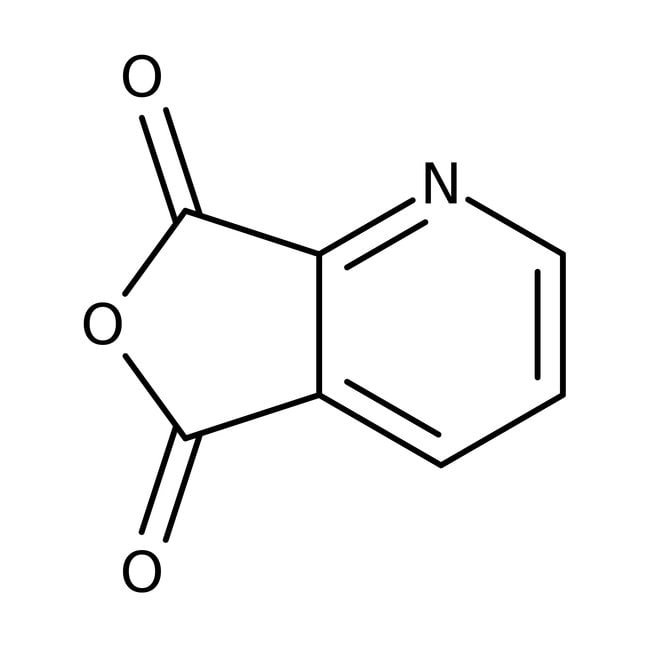

Pyridine-2,3-dicarboxylic anhydride, 98%
Description
Pyridine-2,3-dicarboxylic anhydride is an important raw material and intermediate used in organic synthesis, pharmaceuticals, agrochemicals and dyestuff.
This Thermo Scientific Chemicals brand product was originally part of the Alfa Aesar product portfolio. Some documentation and label information may refer to the legacy brand. The original Alfa Aesar product / item code or SKU reference has not changed as a part of the brand transition to Thermo Scientific Chemicals.
Applications
Pyridine-2,3-dicarboxylic anhydride is an important raw material and intermediate used in organic synthesis, pharmaceuticals, agrochemicals and dyestuff.
Solubility
Optimal solubility in water.
Notes
Moisture sensitive. Store away from moisture and oxidizing agents under dry inert gas. Protect from humidity and water. Incompatible with oxidizing agents and moisture.
Pyridine-2,3-dicarboxylic anhydride is an important raw material and intermediate used in organic synthesis, pharmaceuticals, agrochemicals and dyestuff.
Solubility
Optimal solubility in water.
Notes
Moisture sensitive. Store away from moisture and oxidizing agents under dry inert gas. Protect from humidity and water. Incompatible with oxidizing agents and moisture.
Specifications
Specifications
| Melting Point | 134°C to 138°C |
| Quantity | 5 g |
| Beilstein | 125111 |
| Sensitivity | Moisture sensitive |
| Solubility Information | Optimal solubility in water. |
| Formula Weight | 149.11 |
| Percent Purity | 98% |
| Chemical Name or Material | Pyridine-2,3-dicarboxylic anhydride |
Safety and Handling
| Hazard Category | H315-H319-H335 |
| Hazard Statement | GHS H Statement H315-H319-H335 Causes skin irritation. Causes serious eye irritation. May cause respiratory irritation. |
| Precautionary Statement | P261-P264b-P271-P280-P302+P352-P304+P340-P305+P351+P338-P312-P332+P313-P362-P501c |
| EINECSNumber | 211-834-1 |
| TSCA | Yes |
| Recommended Storage | Ambient temperatures |
RUO – Research Use Only