missing translation for 'onlineSavingsMsg'
Learn More

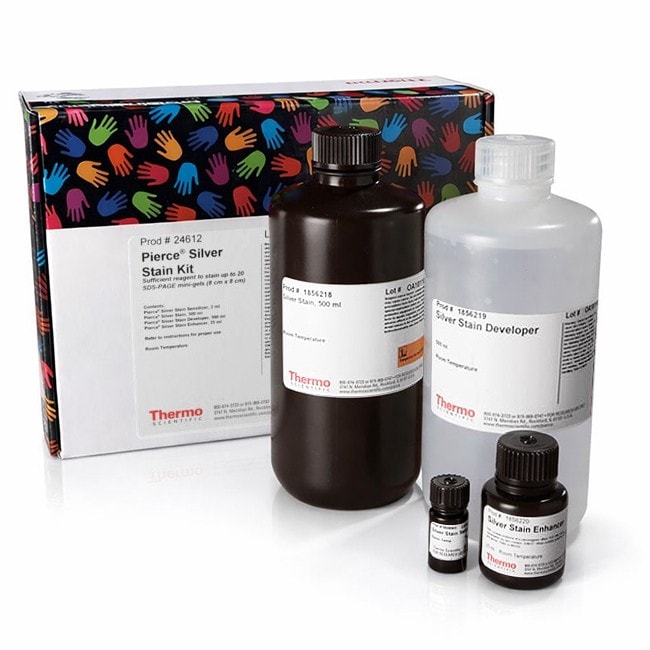
Thermo Scientific™ Pierce™ Silver Stain Kit

Catalog No. PI24612
Change view
Click to view available options
Quantity:
1 L
3 x 1 L
2 product options available for selection
Product selection table with 2 available options. Use arrow keys to navigate and Enter or Space to select.
Catalog No. Quantity
PI24612 1 L
FER24612X3 3 x 1 L
Use arrow keys to navigate between rows. Press Enter or Space to select a product option. 2 options available.
2 options
Catalog No. PI24612 Supplier Thermo Scientific™ Supplier No. 24612
Only null left

Stain proteins in 1D and 2D gels with this rapid, ultra-sensitive and versatile silver stain system that yields consistent and reliable results.

Thermo Scientific™ Pierce Silver Stain Kit is a rapid, ultra-sensitive and versatile silver stain system for protein detection in polyacrylamide gels, yielding consistent and reliable results with many 1D and 2D gel types for both first-time and experienced users.

The Pierce Silver Stain Kit is a rapid, ultra-sensitive, and versatile silver stain system for protein detection in polyacrylamide gels, yielding consistent and reliable results. It is a metallic silver (Ag) protein stain that yields a remarkably clear and uniform gel background. In standard mini gels, proteins are detectable at greater than 0.25 ng per band or spot. The protocol has been optimized for flexibility by allowing short or overnight gel fixation and staining steps without affecting staining performance (sensitivity or clarity). A short (one-minute) sensitization step, performed after gel fixation, yields results that are free of the characteristically dark or blotchy backgrounds often seen with homemade or other commercially available silver stains. This feature is beneficial when performing densitometric analysis of silver stained gels.

Features:

  • Sensitivity—detect proteins at 0.25 ng
  • Protocol—gel staining can be performed within 5 min to 20 hrs, depending on desired sensitivity
  • Gel-compatibility—staining performance is very good with a variety of commercial precast mini-gels and SDS-PAGE buffer-systems
  • Workflow-compatible—mild chemical formulation ensures compatibility with mass spectrometry, sequencing, and other downstream procedures that depend on destaining and protein recovery

Silver staining methods generally use either glutaraldehyde or formaldehyde, which cause some covalent crosslinking of protein to each other. To the extent that this crosslinking occurs, extraction or elution of protein from the gel will be inhibited. Pierce Silver Stain uses formaldehyde in the stain and developer working solutions, but the concentration is low enough that irreversible protein crosslinking is minimized.

Specifications

Content And Storage Sufficient For: 20 mini gels (SDS-PAGE)
• Silver Stain Sensitizer, 2 mL
• Silver Stain, 500 mL
• Silver Stain Enhancer, 25 mL
• Silver Stain Developer, 500 mL

Store at room temperature.
Detection Location In-Gel Detection
Detection Method Colorimetric
Label or Dye Silver
Quantity 1 L
Target Molecule Protein
Product Line Pierce
Product Type Stain Kit
Can nucleic acids be detected with the Thermo Scientific Silver Stain Kit?

Yes. References in the literature and molecular biology protocols indicate that nucleic acids can be detected in polyacrylamide gels with silver stains of this type.

Can the bands be removed and analyzed by mass spectrometry following staining when using the Thermo Scientific Silver Stain Kit?

Yes. See Tech Tip: Process Stained Polyacrylamide Gels for Mass Spectrometry (https://assets.thermofisher.com/TFS-Assets/LSG/Application-Notes/TR0050-Stained-gels-for-MS.pdf). Alternatively, use our Thermo Scientific Silver Stain for MS (Cat No. 24600), which is the same silver stain kit but also includes destaining reagents and a protocol optimized for maximum protein recovery.

What reagents and factors affect silver staining performance when using the Thermo Scientific Silver Stain Kit?

SDS, glycine, amines and phosphates interfere with the staining method; this is why initial wash and fixing steps are necessary. Silver staining is also sensitive to pH conditions, chelators (sequester silver), and strong oxidants or reductants. To avoid these contaminants, use ultrapure water and clean equipment (avoid metal utensils), and avoid touching the gel except at the edges. Prepare working solutions of stain, sensitizer and developer immediately before use.

How critical are the incubation times of other steps in the protocol for the Thermo Scientific Silver Stain Kit?

The 1 minute sensitization and 2 x 1 minute water wash steps are important for optimum stain performance. Development time (2-3 minutes) is also critical, and stop solution must be added as soon as desired development occurs.

How does Thermo Scientific Silver Stain Kit work?

The gel is washed and fixed to remove electrophoresis buffer salts. The silver stain is added, releasing silver ions that interact with the proteins. The developer is then added causing the protein bands to darken as the bound silver reduces. The color development is stopped by lowering the pH with acetic acid.

I used the Thermo Scientific Silver Stain Kit and am getting very high background. Why is this?

Here are possible causes and solutions:

- Stained gel was overdeveloped. Reduce development time.
- Washing step(s) was missed or poor quality water was used. Do not skip or reduce wash steps and use ultrapure water.
- Contaminated equipment was used. Use clean equipment rinsed with ultrapure water.
- Impure chemical was used for gel preparation or precast gel has expired. Use analytical grade chemicals or use precast gels that have not expired.
- Stop solution was not effective in halting development of gel. Prepare new 5% acetic acid and replace it twice in the first minutes of incubation with the gel.

I used the Thermo Scientific Silver Stain Kit and my bands are very faint or not visible at all. What should I do?

Here are possible causes and solutions:

- Insufficient development time. Develop gel for more than 5 minutes or add freshly prepared Developer Working Solution.
- Minimal or no protein present in sample. Check protein concentration in the original sample.
- Improper solution preparation or skipped steps. Check solution preparation and follow procedure.
- Excessive water wash before development step. Wash gel 3 × 10 minutes with ultrapure water, then repeat staining procedure shortening this wash step.

Can gels be dried after staining with the Thermo Scientific Silver Stain Kit?

Yes. Thoroughly wash the gel with water to remove the acetic acid and then soak the gel in a solution containing 5% glycerol and 10% methanol (or 10% ethanol) for one hour before drying in a gel-drying apparatus.

How critical are the fixing and staining times in the protocol for the Thermo Scientific Silver Stain Kit?

The protocol is quite flexible with regard to fixing and staining times. After gels are fixed for at least 30 minutes, they can be stored in water until the next day. The gel-staining time can range from 5 minutes to 24 hours without incurring additional background.

Can a Coomassie-stained gel be secondarily stained with the Thermo Scientific Silver Stain Kit?

Yes. First destain the Coomassie-stained gel to completely remove background. If an acid or methanol destaining solution was used, thoroughly wash the gel with ultrapure water, then proceed with the Thermo Scientific Silver Stain Kit protocol.

Can I process gels stained with Thermo Scientific Silver Stain Kit for mass spectrometry analysis?

Yes, see here (https://tools.thermofisher.com/content/sfs/brochures/TR0050-Stained-gels-for-MS.pdf) for the procedure for processing gels stained with Thermo Scientific Silver Stain, for mass spectrometry analysis. However, for best results, we recommend using the Thermo Scientific Silver Stain for Mass Spectrometry (Cat. No. 24600). This kit includes an optimized procedure and all the necessary reagents for staining gels and destaining gel pieces before in-gel trypsin digestion and mass spectrometry.

What level of detection sensitivity can be expected using the Thermo Scientific Silver Stain Kit?

A detection level of 0.4 ng per protein band has been achieved. Most proteins are easily detectable at low-nanogram (1-5 ng) amounts.

Which types of polyacrylamide gels can be stained with the Thermo Scientific Silver Stain Kit?

The stain performs very well for most polyacrylamide gel types (i.e., suppliers and buffer systems). Both 1D and 2D polyacrylamide gels can be stained with this kit. The default protocol is optimized for gels that are 1.0mm thick; incubation and wash times may require adjustment to achieve optimal results for gels of other thicknesses.

How does the Thermo Scientific Silver Stain Kit work?

The gel is washed and fixed to remove electrophoresis buffer salts. The silver stain is added, releasing silver ions that interact with the proteins. The developer is then added causing the protein bands to darken as the bound silver reduces. The color development is stopped by lowering the pH with acetic acid.

What is the sensitivity of the Thermo Scientific Silver Stain Kit?

The Thermo Scientific Silver Stain Kit detects proteins at 0.25 ng per band.

How should I store the Thermo Scientific Silver Stain Kit and what is its shelf life?

We recommend storing the Thermo Scientific Silver Stain Kit at room temperature where it is stable for a year.


For Research Use Only. Not for use in diagnostic procedures.