Learn More
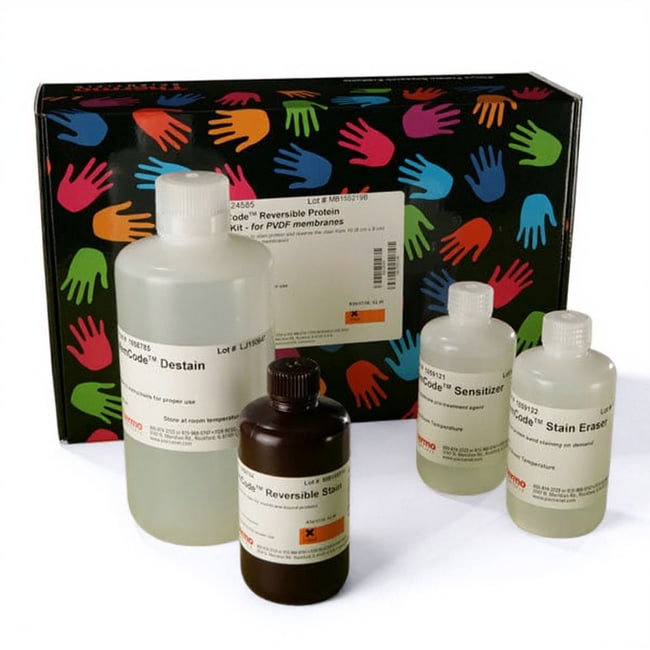
Thermo Scientific™ Pierce™ Reversible Protein Stain Kit for PVDF Membranes
Description
Thermo Scientific™ Pierce Reversible Protein Stain Kits for Membranes are rapid and sensitive alternatives to Ponceau S stain for reversible detection of protein bands on nitrocellulose membrane or PVDF membrane after transfer from polyacrylamide gels.
Highlights:
Better than Ponceau S – more sensitive, easier to document, permanent until reversed (does not fade)
Sensitive – high-avidity, total-protein stain; lower limit of detection equals 25 to 50ng per band
Specific – detects only protein; does not bind or interact with other electrophoresis or sample components
Rapid – stain in less than 5 minutes (nitrocellulose kit) or 30 minutes (PVDF kit); completely erase and reverse staining in less than 15 minutes
Stable – components are stable at room temperature, saving refrigerator space and eliminating equilibration steps
Includes:
Reversible protein stain, destain and eraser solutions; PVDF kit also contains a sensitizer solution
Specifications
Specifications
| Content And Storage | Sufficient For: 10 PVDF membranes (8 cm x 8 cm) from mini gels (SDS-PAGE) • Sensitizer, 250 mL • Reversible Stain, 250 mL • Destain, 1 L • Stain Eraser, 250 mL Store at room temperature. |
| Description | Pierce Reversible Protein Stain Kit for PVDF Membranes |
| Detection Location | In-Blot Detection |
| Detection Method | Colorimetric |
| Label or Dye | Proprietary Mix |
| Quantity | 1.75 L |
| Target Molecule | Protein |
| Product Line | Pierce |
| Product Type | Reversible Protein Stain Kit |
Frequently Asked Questions (FAQs)
The procedure for the Reversible Protein Stain Kit for PVDF Membranes (Cat. No. 24585) is performed before the membrane is blocked with the blocking buffer, and thus, has no effect on the subsequent blocking.
The following are possible causes for weak signal intensity:
- Low level of protein transferred from the gel to the membrane. This is particularly true for high molecular weight proteins. Reversible Protein Stain Kits for Nitrocellulose and PVDF membranes (Cat. Nos. 24580 and 24585, respectively) may be used to stain the bands on the membrane to indicate transfer efficiency.
- Over-diluted primary and secondary antibody probes. We suggest using the recommended dilution for the antibody probes for each substrate. More sensitive substrates will require a more dilute antibody solution.
- Short substrate incubation time. For best results, incubate the membrane for 5-15 min in the SuperSignal substrate.
The following are possible causes for weak signal intensity:
- Low level of protein transferred from the gel to the membrane. This is particularly true for high molecular weight proteins. Reversible Protein Stain Kits for Nitrocellulose and PVDF membranes (Cat. Nos. 24580 and 24585, respectively) may be used to stain the bands on the membrane to indicate transfer efficiency.
- Over-diluted primary and secondary antibody probes. We suggest using the recommended dilution for the antibody probes for each substrate. More sensitive substrates will require a more dilute antibody solution.
- Short substrate incubation time. For best results, incubate the membrane for 5-15 min in the SuperSignal substrate.
Here are possible causes and solutions:
- Membrane was allowed to dry before reversing. Keep the membrane wet.
- High protein concentration in the sample. Extend incubation in the Stain Eraser up to 5 minutes. Reduce the protein concentration in the sample.
This is likely due to low amounts or no protein present in the sample. Please determine the protein concentration in the original sample.
For Research Use Only. Not for use in diagnostic procedures.