Learn More
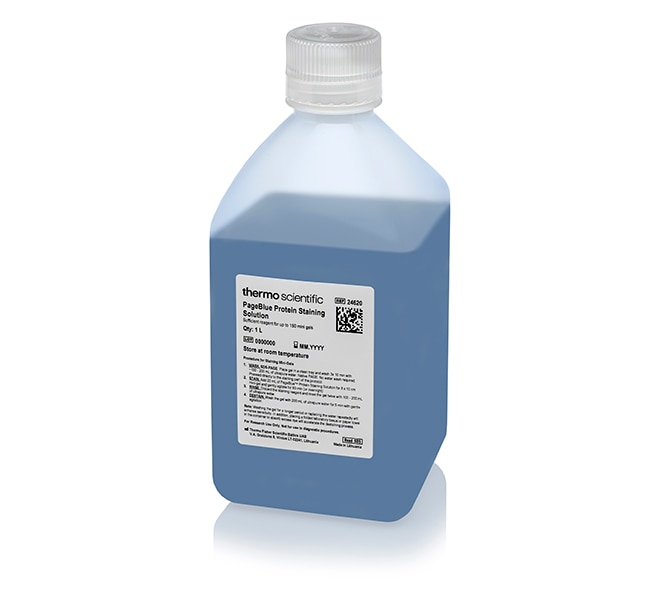
Thermo Scientific™ PageBlue™ Protein Staining Solution
Description
Thermo Scientific Pierce PageBlue Protein Staining Solution is a sensitive, economical formulation of colloidal coomassie G-250 dye for endpoint staining of proteins in polyacrylamide gels and on PVDF membranes without methanol or acetic acid.
PageBlue Protein Staining Solution is a sensitive, economical formulation of colloidal coomassie G-250 dye for endpoint staining of proteins in polyacrylamide gels and on PVDF membranes without methanol or acetic acid. This protein stain delivers a dynamic range of 5 to 500 ng, which is approximately 10 times more sensitive than traditional coomassie R-250-based dyes. Furthermore, PageBlue Protein Staining Solution is economical because it can be reused up to three times without any loss in sensitivity.
Highlights:
- Easy-to-use – simply soak the gel in the ready-to-use solution and observe stained bands without destaining
- Fast – 25 to 40 minute protocol
- Safe – does not contain methanol or acetic acid
- Dynamic range – linear dynamic range of 5 to 500 ng
- Economical – can be reused up to 3 times
Recommended for:
- Visualize and quantify proteins separated in 1D, 2D and IEF polyacrylamide gels
- Stain proteins after transfer onto PVDF membranes
- Stain gels prior to subsequent silver staining or mass spectrometry analysis
Specifications
Specifications
| Content And Storage | Upon receipt store product at room temperature. Product shipped at ambient temperature |
| Detection Location | In-Blot Detection, In-Gel Detection |
| Detection Method | Colorimetric |
| Label or Dye | Coomassie |
| Quantity | 1 L |
| Target Molecule | Protein |
| Product Line | PageBlue |
| Product Type | Protein Staining Solution |
Frequently Asked Questions (FAQs)
This is most likely due to insufficient destaining time. We recommend destaining the membrane in 30% acetonitrile/20% ethanol solution for an additional 5 mins.
This is most likely due to a problem with the western transfer. Please confirm that the transfer buffer and transfer conditions are correct.
Here are possible causes and solutions:
- No protein was present in sample. Load a known amount of purified protein as a control.
- Insufficient amount of protein in sample. Load more total protein in gel.
- SDS not completely removed from gel. Wash gel more extensively before staining.
This is most likely due to SDS interference. We recommend increasing the number of washes and/or wash volumes before staining. Destaining the gel for 5 minutes with 25% isopropanol/10% acetic acid solution or 12% trichloroacetic acid will also help.
Small proteins (less than 10 kDa) are susceptible to leaching from the gel during the staining procedure and require fixation with glutaraldehyde before staining the gel with PageBlue Protein Staining Solution. Other common protein fixatives (e.g., acetic acid, isopropanol, ethanol, TCA, etc.) are not suitable for this purpose, as proteins will be washed out of the gel during the staining procedure. Please see procedure for fixation, mentioned on Page 3 of the manual.
For Research Use Only. Not for use in diagnostic procedures.