Learn More
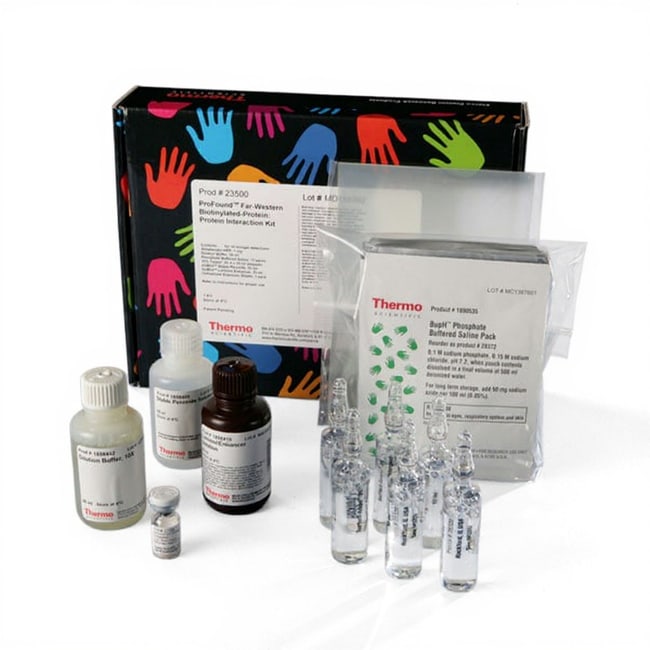
Thermo Scientific™ Pierce™ Far-Western Blot Kit for Biotinylated Proteins
Description
Thermo Scientific™ Pierce Far-Western Blot Kit for Biotinylated Proteins enables in-gel or on-membrane Western blot detection of target proteins via interaction with biotin-labeled test proteins as primary probes.
This far-Western blotting kit provides the reagents and protocol necessary to probe for target proteins by virtue of their interaction with a specific binding partner, which the researcher supplies in purified, biotinylated form. The kit is successful for analysis of protein-protein interactions in which the target (prey) proteins can be bound after they have been separated by gel electrophoresis. The kit includes reagents and procedures for probing and chemiluminescent detection with blots or directly from mini gels.
Highlights:
On-membrane or in-gel detection options – on-membrane detection offers greater sensitivity; in-gel detection is faster and prevents problems associated with incomplete or inefficient transfer
Nonradioactive alternative for far-Western analysis – reliable and sensitive biotin/streptavidin-HRP chemistry combined with chemiluminescent detection offers a practical and safe alternative to radiolabeling the bait protein
Useful interaction range – effective for interaction pairs that have moderate to strong binding associations between the prey and the biotinylated bait protein
Primary antibody-free detection – uses a biotinylated protein as the probe, eliminating the need for primary antibodies or even to have prior knowledge of target-protein identities
Compatible with both SDS-PAGE and native gels – provides option to probe for prey proteins in a more native environment because reduced or denaturing systems may not always allow for the intended interaction
Reduced nonspecific binding – biotin/streptavidin-HRP systems demonstrate less nonspecific binding compared to antibodies directed against the bait protein
Compatible with protein staining – gels can be used for total protein staining after the in-gel chemiluminescent detection step, eliminating the need to run two gels
Includes:
Streptavidin-HRP, dilution buffer, PBS Packs, stable peroxide and luminol enhancer chemiluminescent substrate, detergent solution and pre-cut cellophane sheets
Specifications
Specifications
| Product Type | Western Blot Kit |
| Detection Method | Chemiluminescence |
| Product Line | Pierce |
| Quantity | 220 mL |
| Substrate | Streptavidin-HRP |
| Reactivity | All species |
| Sufficient For | 10 Mini Gels |
| Content And Storage | Sufficient For: 10 mini gel or blot experiments with a biotinylated-protein probe • Streptavidin-HRP Conjugate, 0.1 mg • Dilution Buffer (10X), 50 mL • PBS Packs (each makes 500 mL), 17 packs • Luminol Enhancer, 55 mL • Stable Peroxide Buffer, 55 mL • Surfact-Amps 20 Detergent Solution, 6 x 10 mL • Pre-Cut Cellophane, 10 sheets Store kit at 4°C. |
Frequently Asked Questions (FAQs)
We recommend the biotin kit for endogenously expressed proteins. The reason for this is the wide variety of biotinylation reagents that can be used to label the detection protein of the binding pair. For help choosing a biotinylation reagent, refer to the Biotinylation Selection Guide available at our website.
The biotin kit utilizes streptavidin-HRP to detect the biotinylated protein bound to the prey protein on the membrane. The GST kit utilizes a polyclonal goat anti-GST antibody for detection of the glutathione-S-transferase tagged fusion protein bound to another protein on a membrane.
The Thermo Scientific Pull-Down Protein:Protein Interaction Kits contain a complete, validated set of reagents specifically developed for performing pull-down assays.The kits contain sufficient materials for conducting 25 pull-down assays.
No. Every protein pair will require unique conditions in order to bind with one another. Factors to consider are pH, ionic strength of the buffer, need for cofactors, whether the interaction is long term or transient, etc. The researcher is recommended to perform a literature search or try several different conditions in order to determine what conditions are best for the binding of their proteins of interest. The kit includes a “universal“ wash buffer formed by diluting the lysis buffer 1:1 in TBS.
The prey protein can be detected following transfer on a membrane. The membrane procedures uses 1:100,000 - 1:500,000 dilution of the anti-GST antibody.
For Research Use Only. Not for use in diagnostic procedures.