Learn More
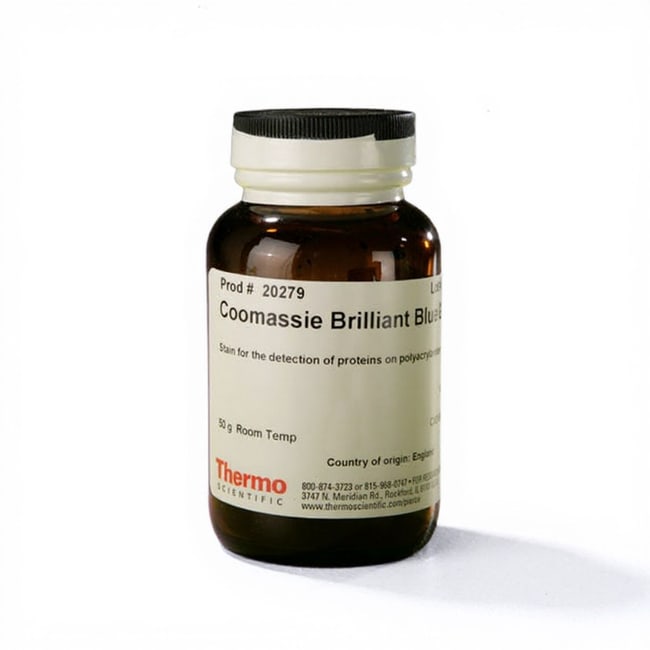

Thermo Scientific™ Pierce™ Coomassie Brilliant Blue Dyes
Description
Thermo Scientific Pierce Coomassie Brilliant Blue dyes are composed of one of the most common forms of coomassie dye, which is a key component of various colorimetric protein gel stains. Coomassie R-250 and G-250 dyes are two chemical forms of a disulfonated triphenylmethane compound that is commonly used as the basis of stains for detection of proteins in gel electrophoresis and Bradford-type assay reagents for protein quantitation. The R-250 (red-tinted) form lacks two methyl groups that are present in the G-250 (green-tinted) form, which is also called colloidal coomassie dye.
Coomassie R-250 and G-250 dyes are two chemical forms of a disulfonated triphenylmethane compound that is commonly used as the basis of stains for detection of proteins in gel electrophoresis and Bradford-type assay reagents for protein quantitation. The R-250 (red-tinted) form lacks two methyl groups that are present in the G-250 (green-tinted) form, which is also called colloidal coomassie dye.
Typically, coomassie gel stains and protein assay reagents are formulated as very acidic solutions in 25 to 50% methanol. In acidic conditions, the dye binds to proteins primarily through basic amino acids (primarily arginine, lysine, and histidine), and the number of coomassie dye ligands bound to each protein molecule is approximately proportional to the number of positive charges found on the protein. Protein binding causes the dye to change from reddish-brown to bright blue (absorption maximum equals 595 nm).
Features include:
- Easy detection—develops intensely colored complexes with proteins
- High sensitivity—can determine as little as 0.5 μg/cm2 of protein present in a gel matrix
- Reversible staining—anion of Coomassie Brilliant Blue dye formed in the acidic staining medium combines with the protonated amino groups of proteins by electrostatic interaction; resulting complex is reversible under proper conditions
- Differentiation between bound and unbound dye—when dissolved in 0.01 M citrate buffer at pH 3.0, has an absorption maximum at 555 nm; protein-dye complex is characterized by a peak slightly broader than that of free dye with a maximum at 549 nm
Specifications
Specifications
| Content And Storage | Store at room temperature. |
| Detection Location | In-Gel Detection, In-Solution Detection, In-Blot Detection |
| Detection Method | Colorimetric |
| Label or Dye | Coomassie Brilliant Blue G-250 |
| Quantity | 50 g |
| Target Molecule | Protein |
| Product Line | Pierce |
| Product Type | Protein Gel Stain |
Frequently Asked Questions (FAQs)
When dissolved in 0.01 M citrate buffer at pH 3.0, it has an absorption maximum at 555 nm; the protein-dye complex is characterized by a peak slightly broader than that of the free dye with an absorption maximum at 549 nm.
In acidic conditions, Coomassie dye primarily binds basic amino acids (arginine, lysine and histidine).
Add 100 mL of glacial acetic acid to 450 mL distilled water.
Dissolve 3 g of Coomassie R-250 dye in 450 mL methanol.
Mix the acetic acid and methanol solutions.
Filter the solution before use.
Yes, Imperial Protein Stain (Cat. Nos. 24615 (1L) and 24617 (3 x 1L) is a ready-to-use colorimetric stain formulated with Coomassie R-250 dye that delivers consistent nanogram-level detection of proteins in polyacrylamide electrophoresis gels.
Coomassie G-250 has an additional methyl group on the lower two central rings in the structure, as compared to Coomassie R-250. Bands stained with Coomassie R-250 are reddish-purple in color; Coomassie G250 bands are greenish-blue in color.
Sometimes referred to as colloidal Coomassie Blue, the G-250 form differs from R-250 in more readily forming dye-dye aggregates in solution. Consequently, G-250 interacts more weakly with polyacrylamide gel matrix than with itself, resulting in lower background that can be more easily washed away.