Learn More
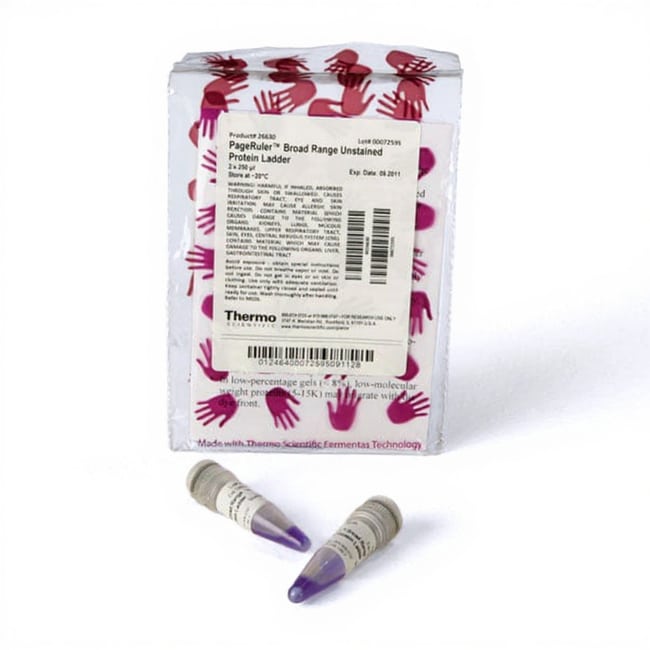
Thermo Scientific™ PageRuler™ Unstained Broad Range Protein Ladder
Description
Thermo Scientific™ PageRuler Unstained Broad Range Protein Ladder is a mixture of 11 proteins (5 to 250kDa) for use as size standards in protein electrophoresis (SDS-PAGE) and Western blotting.
The protein MW markers in this ladder resolve into clearly identifiable sharp bands ranging in size from 5kDa to 250kDa when analyzed by SDS-PAGE and stained with coomassie dye or silver. The 100, 50 and 20kDa protein bands are of greater intensity and serve as reference bands. Proteins can be detected on Western blots by staining with Ponceau S, coomassie blue or other protein stains. In addition, the ladder proteins (except for the 5kDa peptide) contain an integral Strep-tag™ II Sequence and may be detected on Western blots using Strep-Tactin™ Conjugates. The PageRuler Unstained Broad Range Protein Ladder is supplied ready-to-use: no heating, dilution or addition of a reducing agent is required before use.
Highlights:
- Size range – eleven proteins spanning 5 to 250kDa
- Ready-to-use – supplied in a loading buffer for direct loading on gels; no need to boil
- Sharp bands – excellent accuracy for detection in with coomassie or silver stains
- Reference bands – the 100, 50 and 20kDa bands are more intense for easy orientation
- Tagged – each protein in the ladder contains an integral Strep-tag™ II Sequence
- Quality tested – each lot evaluated by SDS-PAGE and Western blotting
Includes:
Proteins in 62.5 mM Tris-H3PO4 (pH 7.5 at 25°C), 1 mM EDTA, 2% SDS, 100 mM DTT, 1 mM NaN3, 0.01% bromophenol blue and 33% glycerol.
Recommended for:
Accurate protein sizing on SDS-polyacrylamide gels and Western blots
Specifications
Specifications
| Content And Storage | Contents: two vials of 250 μL each Storage buffer: 62.5 mM Tris-H3PO4 (pH 7.5 at 25°C), 1 mM EDTA, 2% SDS, 10 mM DTT, 1 mM NaN3, 0.01% bromophenol blue and 33% glycerol Storage: Upon receipt store at -20°C |
| Number of Markers | 11 |
| Ready to Load | Yes |
| Size Range | 5 to 250 kDa |
| Gel Compatibility | Bolt™ Bis-Tris Plus Gels, Novex™ Tricine Gels, Novex™ Tris-Glycine Gels, NuPAGE™ Bis-Tris Gels, NuPAGE™ Tris-Acetate Gels, SDS-PAGE Gels |
| Molecular Weight (g/mol) | 250, 150, 100, 70, 50, 40, 30, 20, 15, 10, 5 kDa |
| Quantity | 2 x 250 μL |
| Shipping Condition | Approved for shipment on Wet or Dry Ice |
| Product Line | PageRuler |
| Product Type | Protein Ladder |
| Show More |
Frequently Asked Questions (FAQs)
The upper bands of the ladder may be degraded by proteases. Ladder, gel, buffer, pipettes, pipette tips, or equipment can be contaminated by proteases during usage. A general recommendation would be to avoid working with proteases in the same room. We would recommend preparing fresh solutions, cleaning the equipment, and using clean pipettes and tips. If the ladder itself is contaminated, please use a new tube of the ladder.
Additional bands can appear due to dithiothreitol (DTT) oxidation in the storage buffer. Please add newly prepared DTT solution to the final concentration of 100 mM and boil for 5 min at 95 degrees C. This should solve the issue. Addition of DTT is NOT recommended for prestained protein ladders, since too high a concentration of reducing agents can cause protein destaining.
No, proteins in Thermo Scientific protein ladders are not His tagged. However, non-specific interaction between the ladder proteins and primary or secondary antibodies is possible and some His-Tag detection systems, such as Thermo Scientific 6xHis Protein Tag Stain Reagent Kit, show non-specific interaction. The protein ladder bands are more readily detected when using high antibody concentrations. The non-specific cross-reactivity is difficult to predict, it often has a different pattern dependent on the antibodies used in each individual experiment. The most general way to handle this problem would be to use lower concentrations of antibodies and to use lower amount of protein ladders. It may also be useful to leave one empty well between the ladder and the sample to overcome a possible leakage of the signal to the nearby sample lane.
PageRuler Unstained protein ladders can be detected directly on Western blots by using Strep-Tactin conjugates or an antibody against the Strep-tag II sequence. All PageRuler and Spectra ladder proteins contain an integral Strep-tag II sequence, however the prestained ladders cannot be detected by Strep-Tactin conjugates.
Protein ladder bands can sometimes be detected with chemiluminescent techniques due to non-specific interactions of ladder proteins with either primary or secondary antibodies (or with both). The ladder bands are only rarely detected by chromogenic substrates. The extremely high sensitivity of the chemiluminescent assays is needed to see the bands, so the actual degree of cross-reactivity is low. The non-specific cross-reactivity is difficult to predict, it often has a different pattern depending on the antibodies used. If antibodies recognize a linear epitope, the cross-reactivity may be due to sequence homology. If antibodies react with a denaturation-resistant conformational epitope it could be impossible to identify the exact reason for detected cross-reactivity. The most general way to handle this problem would be to use lower concentrations of antibodies.
For Research Use Only. Not for use in diagnostic procedures.