Learn More
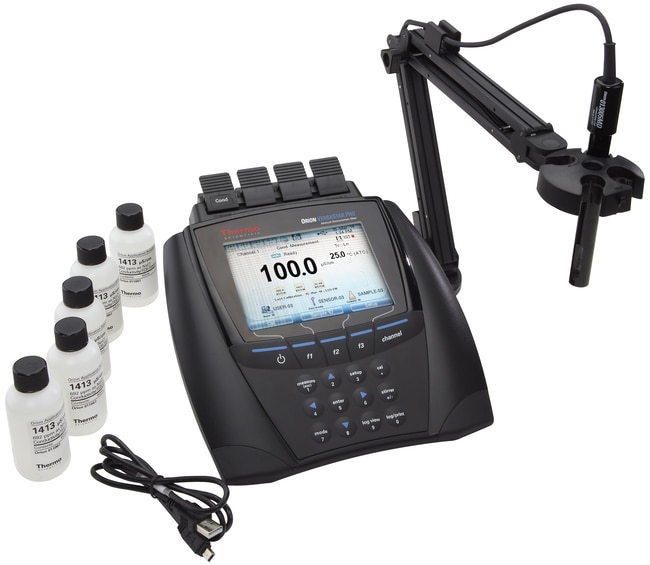


Thermo Scientific™ Orion™ Versa Star Pro™ Conductivity Benchtop Meter
Description
Get high accuracy, premium performance and ultimate flexibility with the Thermo Scientific™ Orion™ Versa Star Pro™ Conductivity Benchtop Meter. Meet your most challenging applications for conductivity, total dissolved solids (TDS), salinity, resistivity and temperature. Easily view measurements on the stunning color display and customize the four meter channels with interchangeable modules. Obtain reliable, fast results with auto-ranging conductivity values and extensive temperature compensation options. Log up to 2000 data point sets with time/date and transfer to printer or computer.
Thermo Scientific Orion Versa Star Pro benchtop meters are designed to meet your most challenging application with ease. Delivering rich functionality and features, you can optimally configure your meter system to meet changing requirements. The Orion Versa Star Pro benchtop meters offer interchangeable measurement modules that allow multiple users to customize four separate channels to meet their specific requirements. Easily view your measurements on a stunning color display with adjustable text sizes. Take the guesswork out of meter calibration and setup with onscreen instructions available in a variety of local languages. Enjoy quick and simple data entry using the numeric keypad.
- Onscreen measurement stability indicator lets you know exactly when your measurements are ready.
- Selectable read modes include Auto-Read to hold a stable reading, Continuous to show changing readings, Timed to log data at specific intervals and Single-Shot to hold a reading after a specific wait time is reached.
- Audible alarms automatically notify you when a set offset value, high/low limit value and calibration time interval are reached.
- Easily access, update and switch your preferred measurement settings, using 10 password-protected methods per channel.
- Uniformly mix solutions using up to two meter-controlled stirrer probes that are easy to position and can be quickly rinsed between samples.
- Data log collects and date/time stamps up to 2000 measurement sets with optional electrode ID, sample ID and account ID.
- Calibration log stores 30 most recent calibrations per parameter.
- Ensure measurement integrity by viewing the active calibration log while taking readings.
- Non-volatile meter memory preserves data and settings, even in the event of power loss.
- Meter facilitates data transfers to a computer via USB or RS232 connections.
- IP54-rated housing resists dust and splashes and can be wall-mounted if table space is limited.
- Meters include CE, TUV 3-in-1 and FCC Class A certifications and 3-year replacement warranty.
Includes Orion Versa Star Conductivity Measurement Module:
- Measure conductivity, TDS, salinity or resistivity with temperature.
- Perform up to a six point conductivity calibration with calibration editing option that allows individual points to be fixed without a full recalibration.
- Auto-ranging conductivity values offer consistent readings across entire measurement range without need to recalibrate.
- Use linear, non-linear, EP (USP) or off conductivity temperature compensation with 5°C, 10°C, 15°C, 20°C or 25°C reference temperatures.
- Customize measurements to show calibration history or simplify to show an extra large conductivity reading.
System Access Feature
Orion Versa Star Pro meters offer a system access feature that is designed to help ensure data integrity by preventing undesired access to various meter functions including date/time setting, data log and calibration log. The System Access feature can be easily turned on or off as the needs of your lab change for ultimate flexibility in operation and ease-of-use. When enabled, the System Access feature allows assignment of a system administrator and up to ten user accounts with customizable access to instrument settings, measurement settings, calibrations and logs. Use the password protection to secure selected meter functions, while leaving other functions accessible for all users. The System Access feature allows you to customize meter access to meet your specific security and data reporting needs.
Specifications
Specifications
| Description | Orion Versa Star Pro conductivity benchtop meter standard sample kit |
| Includes | Orion Versa Star Pro meter, VSTAR-CND conductivity module, 013005MD Orion DuraProbe 4-cell (K=0.475) conductivity sensor, 011007 Orion 1413μS conductivity standard, electrode stand, universal power adapter, literature CD, printed quick start guide, computer interface cable and meter test certificate |
| Accuracy (Conductivity) | 0.5% of reading ±1 digit > 3 μS; 0.5% of reading ±0.01 μS ≤ 3 μS |
| Outputs | USB (2), RS232 |
| Measurement Modes | Conductivity, TDS, Salinity, Resistivity with Temperature |
| Compatible Probes | 2-cell or 4-cell conductivity sensors with built-in temperature |
| Cell Constant | 0.001 to 199.9 cm-1 |
| Calibration | Conductivity with calibration editing option and temperature |
| Calibration Points (Conductivity) | 6 |
| Range (Conductivity) | 0.001 μS/cm to 3000 mS/cm |
| Show More |
Frequently Asked Questions (FAQs)
At Thermo Fisher Scientific, we stand behind the quality and reliability of our instruments. That's why we offer a minimum two-year (2) warranty on all Orion benchtop and portable conductivity meters. Obtain peace of mind knowing that your investment is protected. Should any issues arise within the warranty period, our team of experts is committed to providing you with prompt and efficient service. Be sure to check instrument specifications to confirm the warranty coverage period.
Calibration is an important step to obtaining accurate results on your Orion benchtop or portable conductivity meter. Before beginning the calibration process, ensure that you are utilizing freshly poured, non-expired calibration standards to ensure accurate results. Follow the steps below to calibrate your conductivity meter.
• Prepare the calibration standards: Obtain at least one conductivity reference standard with a known conductivity value near the expected sample conductivity range. Ideally, use one standard close to the expected conductivity of your sample, and additional standards for different conductivity ranges. Ensure that the standards are fresh and have not expired.
• Clean the probe: Rinse the probe with distilled or deionized water to remove any debris or contaminants. If necessary, gently wipe the probe with a soft cloth or tissue.
• Turn on the conductivity meter: Power on the conductivity meter and allow it to warm up, if needed.
• Immerse the probe: Immerse the probe into a beaker containing the first calibration standard. Ensure that the probe is fully submerged and that it is not touching the sides or bottom of the beaker.
• Allow stabilization: Allow the conductivity reading to stabilize. This may take a few moments, depending on the specific meter and standard being used. The reading should become steady and remain constant.
• Adjust the conductivity value: Using the calibration controls on the conductivity meter, adjust the reading to match the known conductivity value of the calibration standard. Reference the user manual for specific guidance on adjusting the conductivity.
• Rinse the probe: After calibration, rinse the probe with distilled or deionized water to remove any residual calibration solution.
• Repeat calibration: Repeat the calibration steps with the second calibration standard, following the same process as before.
• Verify accuracy: After calibration, it is recommended to check the conductivity meter's accuracy by measuring a conductivity solution of known value. This can help ensure the reliability of your measurements.
To learn more about conductivity calibration, maintenance and beyond, download our user guide: Orion Conductivity Probe User Guide
Before beginning an analysis on your Orion benchtop or portable conductivity meter, assemble your materials. You will need a conductivity probe suitable for your application, calibration standards, and a test sample. Follow the steps below to obtain your conductivity analysis.
• Calibrate the conductivity meter: Start by calibrating your conductivity meter using at least one calibration standard. Typically, you will need at least one standard with a known conductivity value near the expected sample conductivity range. Be sure to reference the user manual for instructions on how to properly calibrate your conductivity meter.
• Prepare your sample: Ensure that your sample is at the desired temperature (most frequently room temperature).
• Immerse the electrode: Dip the conductivity probe into the sample. Avoid touching the sides or bottom of the container to prevent inaccurate readings.
• Allow for stabilization: Give the conductivity meter some time to stabilize and reach a steady reading. This may take a few seconds to a minute depending on your meter and the characteristics of the sample.
• Record the conductivity value: Once the conductivity meter stabilizes, record the conductivity value and temperature value displayed on the meter. Take note of any temperature compensation settings if applicable.
• Rinse the probe: After each measurement, rinse the probe with distilled or deionized water to remove any residue or contaminants. This ensures accurate subsequent readings.
• Repeat (if necessary): If you need to analyze multiple samples, repeat the process with each sample, recalibrating the conductivity meter if required.
To learn more about how to get accurate conductivity measurements, download the smart note: Top 10 Mistakes to Avoid When Measuring Conductivity in Liquids.
When choosing an Orion conductivity probe for your application there are many factors to consider. Measurement range, sample type, container dimensions, accuracy/ precision requirements, temperature compensation needs, cell constant, durability, maintenance, and meter compatibility are all key features to evaluate.
To learn more about Orion conductivity probes, download the brochure: Orion Conductivity Probes
To perform an analysis using Orion benchtop and portable conductivity meters, you will need the following supplies: conductivity probe, conductivity standards, distilled or deionized water, sample containers, and a stirrer probe (optional).