Learn More
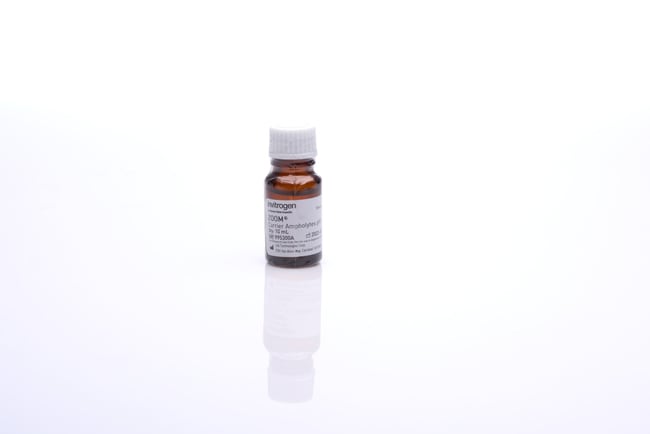
Invitrogen™ ZOOM™ Carrier Ampholytes pH 6-9

Description
Use Carrier Ampholytes with the ZOOM IPGRunner™ System which consists of three main components: ZOOM IPGRunner Mini-Cell, ZOOM IPGRunner Cassettes and 7cm ZOOM Strips.
- ZOOM Carrier Ampholytes sort based on their isoelectric points in an electric field, thereby establishing a pH gradient in solution or contributing to the gradient when used with IPG strips
- Carrier ampholytes help stabilize the pH gradient and current in IPG strips and aid in protein solubility, resulting in reproducible IEF resolution
2D Gel Electrophoresis, IsoElectric Focusing, Protein Gel Electrophoresis, Protein Sample Fractionation, Protein Sample Preparation and Protein Purification, Proteins, Expression, Isolation and Analysis
Specifications
Specifications
| Content And Storage | ZOOM™ Carrier Ampholytes are supplied as 10 ml bottles. Store at +4°C. Guaranteed stable for 1 year when properly stored. |
| pH Range | pH 6-9 |
| Quantity | 10 mL |
| Shipping Condition | Room Temperature |
| Product Line | ZOOM |
| Product Type | Carrier Ampholyte |
Frequently Asked Questions (FAQs)
There are several reasons why streaking may occur.
(1) Sample is not completely solubilized prior to application.
(2) Sample is poorly soluble in rehydration solution.
(3) Non-protein impurities in the sample can interfere with IEF, causing horizontal streaking in the final 2-D result, particularly toward the acidic side of the gel.
(4) Ionic impurities are present in sample.
(5) Ionic detergent is present in sample.
(6) Sample load is too high.
(7) Underfocusing. Focusing time was not long enough to achieve steady state focusing.
(8) Overfocusing. Extended focusing times (over 100,000 Vh) may result in electroendosmotic water and protein movement, which can produce horizontal smearing.
What should be done?
(1) Be sure that the sample is completely and stably solubilized. Note: Repeated precipitation-resolubilization cycles produce or increase horizontal streaking.
(2) Increase the concentration of the solubilizing components in the rehydration solution.
(3) Modify sample preparation to limit these contaminants or dialyze protein.
(4) Reduce salt concentration to below 10 mM by dilution or desalt the sample by dialysis. Precipitation with TCA and acetone and subsequent resuspension is another effective desalting technique that removes lipids, nucleotides and other small molecules.
Note: Specific and non-specific losses of proteins can occur with dialysis, gel chromatography, and precipitation/resuspension of samples. If the sample preparation cannot be modified, the effect of ionic impurities can be reduced by modifying the IEF protocol. Limit the voltage to 100-150 V for 2 hours, then resume a normal voltage step program. This pre-step allows the ions in the sample to move to the ends of the IPG strip.
(5) If the ionic detergent SDS is used in sample preparation, the final concentration must not exceed 0.25% after dilution into the rehydration solution. Additionally, the concentration of the non-ionic detergent present must be at least 8 times higher than the concentration of any ionic detergent to ensure complete removal of SDS from the proteins.
(6) Extend focusing time. Load less sample.
(7) Prolong focusing time.
(8) Reduce focusing time.
Proteins are ampholytes, but in general they are poor carrier ampholytes. The profiles of the fractions are similar, but not identical, to those obtained with ampholytes in the sample.
We do not recommend heating protein samples containing urea over 37 degrees C as elevated temperatures cause urea to hydrolyze to isocyanate, which modifies proteins by carbamylation.
We recommend storing them at -80 degrees C. We do not recommend storing them at -20 degrees C
The recommended ampholyte concentration in the sample rehydration buffer is 0.5%.
*If you are loading 5-50 µg of protein (pure protein or crude lysate) per ZOOM strip, use 0.5% ampholytes in the sample rehydration buffer.
*If you are loading >50 µg of protein (crude lysate or fractionated sample) per ZOOM Strip, use 0.5-2% ampholytes in the sample rehydration buffer.
Note: Higher ampholyte concentration requires longer focusing times.
For Research Use Only. Not for use in diagnostic procedures.