Learn More
Invitrogen™ Lumio™ Green Detection Kit
Description
Includes
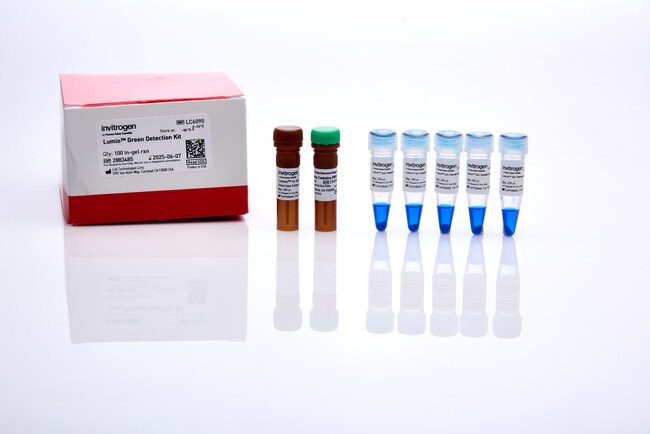
The Lumio™ Green Detection Kit contains one vial of Lumio™ Green Detection Reagent, five vials of Lumio™ Gel Sample Buffer, and one vial of Lumio™ In-Gel Detection Enhancer.
The Lumio™ Green Detection Kit is a sensitive and highly specific kit for labeling Lumio™ fusion proteins prior to electrophoresis.
- Label proteins fused to a Lumio sequence
- Visualize results immediately after electrophoresis, eliminate gel staining and western blotting
- Detect nanogram levels of protein with UV transilluminator, equipped with standard camera (Figure 1), or laser-based scanner
Enzyme and Protein Activity Assays, Lumio Detection, Protein Gel Electrophoresis, Protein Gel Staining and Imaging, Proteins, Expression, Isolation and Analysis, Reporter Assays
Order Info
Shipping Condition: Dry Ice
Specifications
Specifications
| Content And Storage | The Lumio™ Green Detection Kit contains one vial of Lumio™ Green Detection Reagent, five vials of Lumio™ Gel Sample Buffer, and one vial of Lumio™ In-Gel Detection Enhancer. Store at -20°C. All components are guaranteed stable for 6 months when properly stored. |
| Detection Location | In-Gel Detection |
| Detection Method | Fluorescence |
| Label or Dye | Lumio Green |
| Quantity | 1 kit |
| Shipping Condition | Dry Ice |
| Target Molecule | Proteins (Lumio™-Tagged) , Proteins (TC-Tagged) |
| Product Line | Lumio |
| Product Type | Pre-Gel Fusion Protein Labeling Kit |
Frequently Asked Questions (FAQs)
The Lumio reagent is hydrophobic and can easily pass through the membrane. There is no need to permeabilize the membrane in order to get this reagent into cells.
Serum proteins such as BSA (66 kDa) from the mammalian cell culture medium may cross-react with the Lumio reagent, producing non-specific bands. Removing the cell culture medium and washing the mammalian cells 3-4 times with PBS after harvesting the cells minimizes the non-specific binding from BSA.
We have not experienced negative effects with Lumio reagents at the concentrations used to detect protein in the cells. We also do not see any change in cell morphology when using Lumio Green. After application of the Lumio Red, we do see some minor morphological changes in the cells that are reversed after 24 hours of application of the reagent.
The advantage of Lumio staining is that one can do both in vivo and in vitro protein labeling. For in vivo labeling, load the cells with the Lumio reagent and then visualize the cells/proteins under a fluorescence microscope. This is similar to the GeneBLAzer detection procedure except that GeneBLAzer detection is based on an enzymatic reaction that amplifies the reporter signal. GFP fluorescence can only be detected within the cell (in vivo) because proper protein folding is needed. The Lumio tag is very small (6 amino acids, 585 Da), in contrast to the bla protein in GeneBLAzer detection (264 amino acids, 29 kDa) and the GFP protein (27 kDa), and therefore most likely will not interfere with the function of the protein it is fused to. GFP has the disadvantage of being a large fusion tag and is not an enzymatic-based reporter system. Unlike GeneBLAzer detection and GFP, a Lumio-tagged protein can be visualized on a gel after treating the cell lysate or protein with the Lumio reagent. Compared to Lumio and GFP, GeneBLAzer detection is a more sensitive detection method for use in live cells. Also unlike Lumio and GFP, the GeneBLAzer detection method allows for ratiometric read-outs and thus eliminates sample-to-sample variation.
Yes, fluorescent protein-expressing cells can be fixed using 4% paraformaldehyde in PBS for 10 min followed by one quick PBS rinse and 3 x 5 min washes with 1 mL PBS.
For Research Use Only. Not for use in diagnostic procedures.