missing translation for 'onlineSavingsMsg'
Learn More

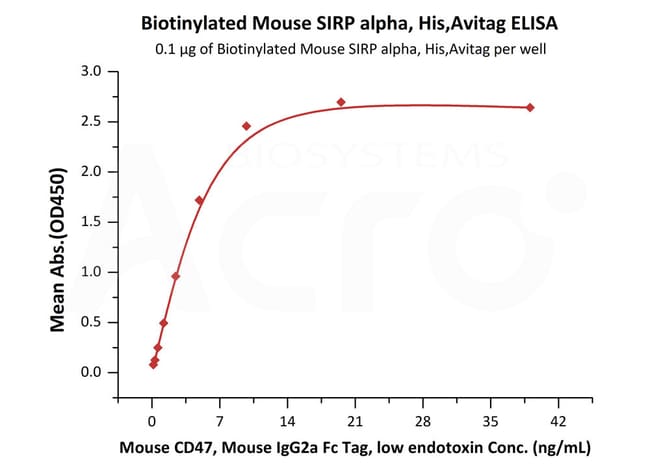
ACROBiosystems Inc Biotinylated Mouse SIRP alpha, His,Avitag (SIA-M82E2) is expressed from human 293 cells (HEK293). It contains AA Lys 32 - Asn 373 (Accession # P97797-1).

Catalog No. 502231346
Encompass

Tyrosine-protein phosphatase non-receptor type substrate 1 (SHPS1) is also known as CD172 antigen-like family member A (CD172a), Macrophage fusion receptor, MyD-1 antigen, Signal-regulatory protein alpha (SIRPA or SIRP alpha) or p84, is a member of the SIRP family, and also belongs to the immunoglobulin superfamily. SIRP alpha is Ubiquitous and highly expressed in brain. SIRPA / CD172a is immunoglobulin-like cell surface receptor for CD47 and acts as docking protein and induces translocation of PTPN6, PTPN11 and other binding partners from the cytosol to the plasma membrane. SIRPA / SHPS-1 supports adhesion of cerebellar neurons, neurite outgrowth and glial cell attachment and may play a key role in intracellular signaling during synaptogenesis and in synaptic function By similarity.
Catalog No. 502231346 Supplier ACROBiosystems Inc Supplier No. SIAM82E225UG

Please call Customer Service at 1-800-234-7437 or send an email to help@thermofisher.com for assistance.

Tyrosine-protein phosphatase non-receptor type substrate 1 (SHPS1) is also known as CD172 antigen-like family member A (CD172a), Macrophage fusion receptor, MyD-1 antigen, Signal-regulatory protein alpha (SIRPA or SIRP alpha) or p84, is a member of the SIRP family, and also belongs to the immunoglobulin superfamily. SIRP alpha is Ubiquitous and highly expressed in brain. SIRPA / CD172a is immunoglobulin-like cell surface receptor for CD47 and acts as docking protein and induces translocation of PTPN6, PTPN11 and other binding partners from the cytosol to the plasma membrane. SIRPA / SHPS-1 supports adhesion of cerebellar neurons, neurite outgrowth and glial cell attachment and may play a key role in intracellular signaling during synaptogenesis and in synaptic function By similarity.