Learn More
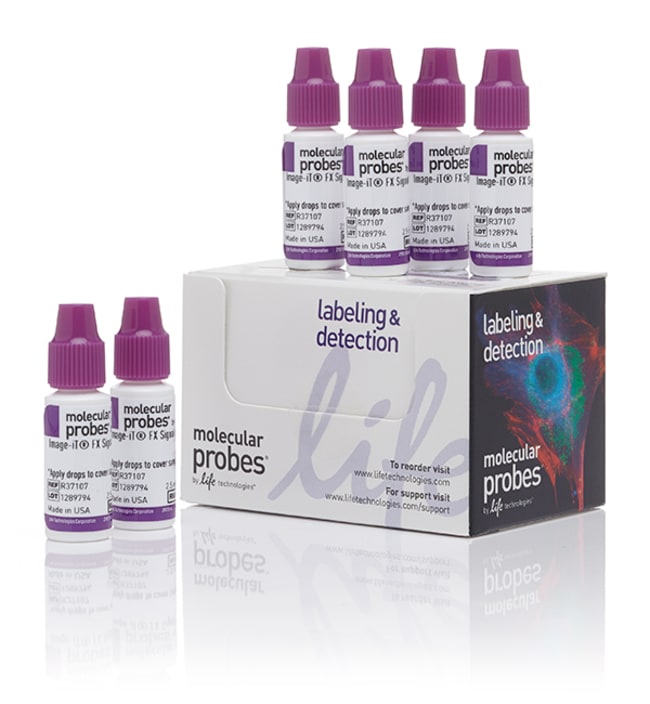
Invitrogen™ Image-iT™ FX Signal Enhancer ReadyProbes™ Reagent
Description
Image-iT™ FX Signal Enhancer ReadyProbes™ Reagent dramatically reduces background fluorescence resulting from non-specific staining during secondary detection using conjugates of streptavidin or secondary antibodies. This reagent is applied directly to slides or coverslips containing fixed and permeabilized cell or tissue samples prior to staining with fluorescent probes.
- Easy protocol—apply ready-made solution using a dropper bottle
- Compatible with the other steps in your immunostaining protocol
- Effective with most fluorescent labels
- Stable at room temperature—keep handy at your scope or cell culture area
Cell imaging applications
Image-iT™ FX Signal Enhancer reagent is a highly effective product for blocking background staining that results from the nonspecific interactions of a wide variety of fluorescent dyes with cell and tissue constituents. Background staining seen with fluorescent conjugates of streptavidin and antibody conjugates are largely eliminated when the Image-iT™ FX Signal Enhancer reagent is applied to fixed and permeabilized cells prior to staining.
Suggestions for use
- Apply Image-iT™ FX Signal Enhancer reagent directly to slides or coverslips containing cell or tissue samples prior to immune-staining.
- After the fix/perm step, simply wash and add enough drops to cover your sample, then incubate for 30 min. and proceed with your normal staining protocol.
- Additional blocking steps may be performed subsequent to blocking with the Image-iT™ Signal Enhancer ReadyProbes™ Reagent, as needed
Specifications
Specifications
| Content And Storage | 2.5 mL dropper bottles Store at ≤25°C. |
| Product Line | Image-iT, ReadyProbes |
| Product Type | Signal Enhancer |
| Quantity | 6 x 2.5 mL kit |
| Solution Type | Signal Enhancer |
| Format | Bottle(s) |
Frequently Asked Questions (FAQs)
The Image-iT FX Signal Enhancer reduces non-specific binding of dye conjugates by blocking positively-charged areas of cells or tissues that attract negatively-charged dyes. In cells after fixation, some positively-charged structures are the nuclei and mitochondria. Thus, you would expect to see a reduction in both mitochondrial and nuclear signal. The lower signal you see afterward is the specific mitochondrial signal; the fluorescence that was lost was the non-specific labeling.
No. Image-iT FX Signal Enhancer is not a protein blocker, like BSA, normal serum, or other commercial antibody blockers. Use it as a separate step to block non-specific charge-based binding of dyes to cellular components.
This is most likely charge-based binding due to interactions of the charge on the dyes with cellular components of opposite charge. This can be blocked by using the Image-iT FX Signal Enhancer Solution which eliminates non-specific binding due to charge. The Signal Enhancer is applied as a pre-blocking step and your regular blocking regimen should be used to limit non-specific binding due to protein-protein interactions. Signal Enhancer cannot be used on live cells.
This is not recommended. The ReadyProbes reagents were developed for imaging applications whereas the Ready Flow reagents were optimized for flow cytometry.
The click reaction is very selective between an azide and alkyne. No other side reactions are possible in a biological system. Any non-specific background is due to non-covalent binding of the dye to various cellular components. The Select FX Signal Enhancer is not effective at reducing non-specific charge-based binding of dyes following the click reaction; we do not recommend its use with the Click-iT detection reagents. The best method to reduce background is to increase the number of BSA washes. You should always do a no-dye or no-click reaction control under the same processing and detection conditions to verify that the background is actually due to the dye and not autofluorescence. You can also perform the complete click reaction on a carrier solvent-only, no EdU or no-EU control to verify the specificity of the click reaction signal.
For Research Use Only. Not for use in diagnostic procedures.