missing translation for 'onlineSavingsMsg'
Learn More

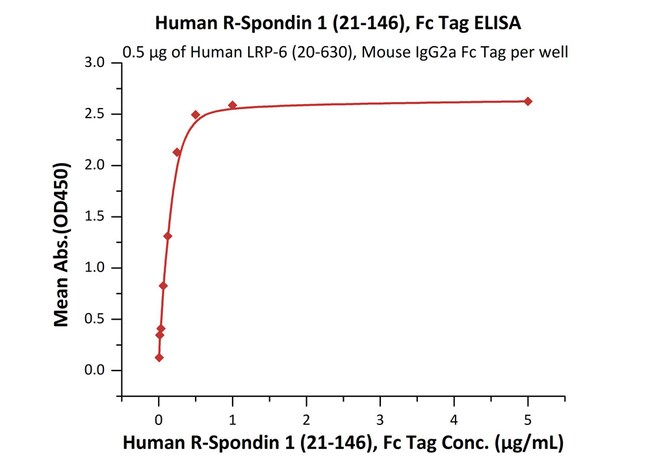
ACROBiosystems Inc Human R-Spondin 1 (21-146), Fc Tag (RS1-H5269) is expressed from human 293 cells (HEK293). It contains AA Ser 21 - Ala 146 (Accession # Q2MKA7-1).

Catalog No. 502253155
Encompass

R-spondin-1 is also known as Roof plate-specific Spondin 1 (RSPO1) and cysteinerich and single thrombospondin domain containing protein 3 (Cristin 3), which is a secreted protein which belongs to the R-Spondin family and encodes a secreted activator protein with two cystein-rich, furin-like domains and one thrombospondin type 1 domain. All Rspondins regulate Wnt/-catenin signaling, but have distinct expression patterns. Like other R-Spondins, R-Spondin-1 contains two adjacent cysteinerich furinlike domains (aa 34-135) with one potential N-glycosylation site, followed by a thrombospondin (TSP1) motif (aa 147-207) and a region rich in basic residues (aa 211-263). Only the furinlike domains are needed for -catenin stabilization. A putative nuclear localization signal at the C-terminus may allow some expression in the nucleus.
Catalog No. 502253155 Supplier ACROBiosystems Inc Supplier No. RS1H526950UG

Please call Customer Service at 1-800-234-7437 or send an email to help@thermofisher.com for assistance.

R-spondin-1 is also known as Roof plate-specific Spondin 1 (RSPO1) and cysteinerich and single thrombospondin domain containing protein 3 (Cristin 3), which is a secreted protein which belongs to the R-Spondin family and encodes a secreted activator protein with two cystein-rich, furin-like domains and one thrombospondin type 1 domain. All Rspondins regulate Wnt/-catenin signaling, but have distinct expression patterns. Like other R-Spondins, R-Spondin-1 contains two adjacent cysteinerich furinlike domains (aa 34-135) with one potential N-glycosylation site, followed by a thrombospondin (TSP1) motif (aa 147-207) and a region rich in basic residues (aa 211-263). Only the furinlike domains are needed for -catenin stabilization. A putative nuclear localization signal at the C-terminus may allow some expression in the nucleus.