missing translation for 'onlineSavingsMsg'
Learn More

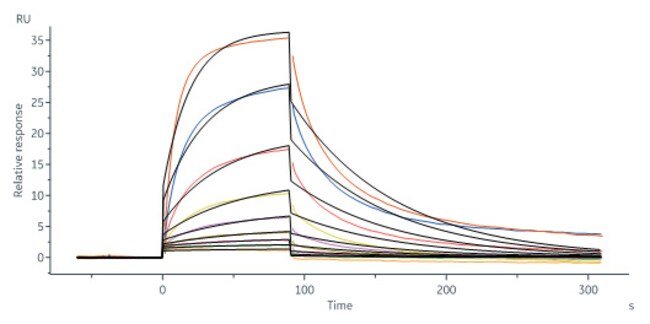
ACROBiosystems Inc Biotinylated Human IL-13 R alpha 1, Fc,Avitag (IL1-H82F6) is expressed from human 293 cells (HEK293). It contains AA Gly 22 - Thr 343 (Accession # NP_001551.1).

Catalog No. 502230920
Encompass

Interleukin 13 receptor, alpha 1 is also known as IL13RA1, NR4 and CD213A1 (cluster of differentiation 213A1), The IL13 R1 cDNA encodes a 427 amino acid (aa) residue precursor protein with a putative 21 aa residue signal peptide, a 324 aa residue extracellular domain, a 23 aa residue transmembrane region and a 59 aa residue cytoplasmic tail. Human and mouseIL13R1 share 76% aa sequence identity. IL13RA1 is a subunit of the interleukin 13 receptor. This subunit forms a receptor complex with IL4 receptor alpha, a subunit shared by IL13 and IL4 receptors. This subunit serves as a primary IL13-binding subunit of the IL13 receptor, and may also be a component of IL4 receptors. This protein has been shown to bind tyrosine kinase TYK2, and thus may mediate the signaling processes that lead to the activation of JAK1, STAT3 and STAT6 induced by IL13 and IL4.
Catalog No. 502230920 Supplier ACROBiosystems Inc Supplier No. IL1H82F625UG

Please call Customer Service at 1-800-234-7437 or send an email to help@thermofisher.com for assistance.

Interleukin 13 receptor, alpha 1 is also known as IL13RA1, NR4 and CD213A1 (cluster of differentiation 213A1), The IL13 R1 cDNA encodes a 427 amino acid (aa) residue precursor protein with a putative 21 aa residue signal peptide, a 324 aa residue extracellular domain, a 23 aa residue transmembrane region and a 59 aa residue cytoplasmic tail. Human and mouseIL13R1 share 76% aa sequence identity. IL13RA1 is a subunit of the interleukin 13 receptor. This subunit forms a receptor complex with IL4 receptor alpha, a subunit shared by IL13 and IL4 receptors. This subunit serves as a primary IL13-binding subunit of the IL13 receptor, and may also be a component of IL4 receptors. This protein has been shown to bind tyrosine kinase TYK2, and thus may mediate the signaling processes that lead to the activation of JAK1, STAT3 and STAT6 induced by IL13 and IL4.