missing translation for 'onlineSavingsMsg'
Learn More

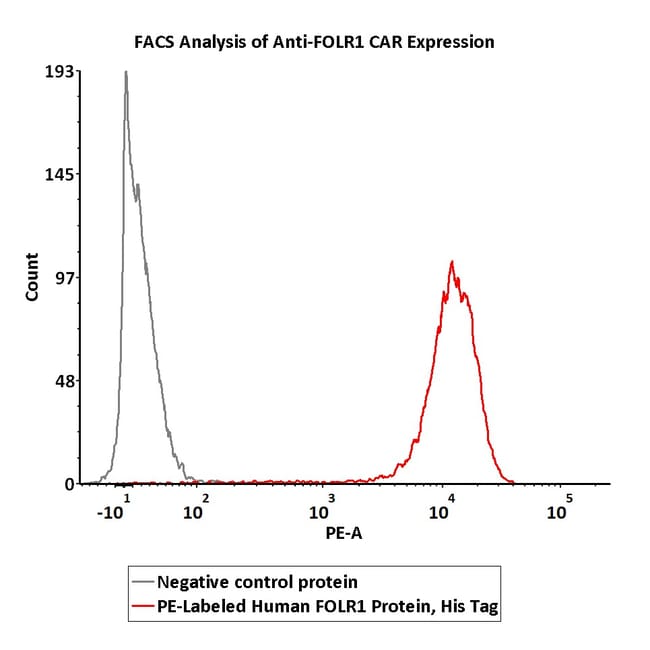
ACROBiosystems Inc PE-Labeled Human FOLR1, His Tag (FO1-HP2H9) is produced via site-specific conjugation of PE to Human FOLR1, His Tag under optimal conditions with a proprietary technology.It contains AA Arg 25 - Met 233 (Accession # P15328-1).

Catalog No. 502231276
Encompass

Folate Receptor 1 (FOLR1) is also known as Folate receptor alpha, Folate Binding Protein (FBP), FOLR, and is a member of the folate receptor (FOLR) family. Members of this gene family have a high affinity for folic acid and for several reduced folic acid derivatives, and mediate delivery of 5-methyltetrahydrofolate to the interior of cells. Mature FOLR1 is an N-glycosylated protein that is anchored to the cell surface by a GPI linkage. FOLR1 is predominantly expressed on epithelial cells and is dramatically upregulated on many carcinomas. FOLR1 is internalized to the endosomal system where it dissociates from its ligand before recycling to the cell surface. A soluble form of FOLR1 can be proteolytically shed from the cell surface into the serum and breast milk. Defects in FOLR1 are the cause of neurodegeneration due to cerebral folate transport deficiency (NCFTD). NCFTD is an autosomal recessive disorder resulting from brain-specific folate deficiency early in life.
Catalog No. 502231276 Supplier ACROBiosystems Inc Supplier No. FO1HP2H9200TESTS

Please call Customer Service at 1-800-234-7437 or send an email to help@thermofisher.com for assistance.

Folate Receptor 1 (FOLR1) is also known as Folate receptor alpha, Folate Binding Protein (FBP), FOLR, and is a member of the folate receptor (FOLR) family. Members of this gene family have a high affinity for folic acid and for several reduced folic acid derivatives, and mediate delivery of 5-methyltetrahydrofolate to the interior of cells. Mature FOLR1 is an N-glycosylated protein that is anchored to the cell surface by a GPI linkage. FOLR1 is predominantly expressed on epithelial cells and is dramatically upregulated on many carcinomas. FOLR1 is internalized to the endosomal system where it dissociates from its ligand before recycling to the cell surface. A soluble form of FOLR1 can be proteolytically shed from the cell surface into the serum and breast milk. Defects in FOLR1 are the cause of neurodegeneration due to cerebral folate transport deficiency (NCFTD). NCFTD is an autosomal recessive disorder resulting from brain-specific folate deficiency early in life.