Learn More
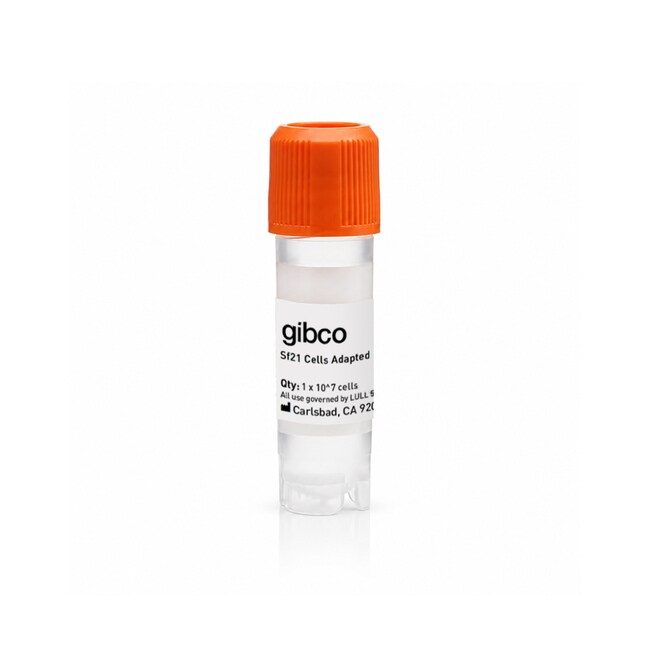
Gibco™ Sf21 cells in Sf-900™ II SFM

Description
Gibco Sf21 cells are adapted to serum-free suspension culture in Gibco Sf-900™ II SFM, which saves significant time and expense associated with the adaptation of cultures.
- Recombinant protein expression from a variety of expression systems
- Good growth in adherent or suspension culture
- Documented lineage from a low passage Master Cell Bank
- Quality and performance testing
Bioproduction, Cell Culture, High-level Protein Production in Insect Cells, Insect Cell Culture, Insect Expression, Insect Expression Cell Lines, Protein Expression, Proteins, Expression, Isolation and Analysis, Sf9 and Sf21 Cell Culture, Viral Vaccine Production
Order Info
Shipping Condition: Dry Ice
Specifications
Specifications
| Content And Storage | Storage conditions: Liquid nitrogen (vapor phase) Shipping conditions: Frozen |
| Cell Line | Sf21 |
| Cell Type | Insect Cells |
| Species | S. frugiperda |
| Media Recommendation | Sf-900 II SFM (Serum-Free Media) |
| Product Type | Insect Cells |
| Quantity | 1.5 mL |
| Shipping Condition | Dry Ice |
Frequently Asked Questions (FAQs)
The following protocol describes a general procedure for thawing cryopreserved cells. For detailed protocols, always refer to the cell-specific product insert.
1. Remove the cryovial containing the frozen cells from liquid nitrogen storage and immediately place it into a 37°C water bath.
2. Quickly thaw the cells (< 1 minute) by gently swirling the vial in the 37°C water bath until there is just a small bit of ice left in the vial.
3. Transfer the vial into a laminar flow hood. Before opening, wipe the outside of the vial with 70% ethanol.
4. Transfer the desired amount of pre-warmed complete growth medium appropriate for your cell line dropwise into the centrifuge tube containing the thawed cells.
5. Centrifuge the cell suspension at approximately 200 x g for 5-10 minutes. The actual centrifugation speed and duration varies depending on the cell type.
6. After the centrifugation, check the clarity of supernatant and visibility of a complete pellet. Aseptically decant the supernatant without disturbing the cell pellet.
7. Gently resuspend the cells in complete growth medium, and transfer them into the appropriate culture vessel and into the recommended culture environment.
Note: The appropriate flask size depends on the number of cells frozen in the cryovial, and the culture environment varies based on the cell and media type.
Insect cells do not require CO2 or high humidity to grow, they can grow in a lab drawer at room temperature. We recommend this so people don't waste CO2 and other resources necessary for maintaining a tissue culture incubator. It should be noted, however, that the cells will grow in a humidified incubator.
Many antibiotics are suitable for use with insect cells. The following antibiotics are commonly used:
- Penicillin/Streptomycine: 50-100 U/mL; 50-100 µg/mL
- Amphotericin B (Fungizone antimycotic): 0.25 µg/mL
- Gentamicin: 0.5 mL of 10 mg/mL solution in 500 mL media (final concentration: 10 µg/mL)
Heat inactivation is not necessary. Our team has routinely used serum that has not been heat-inactivated, and we have not observed any effect on cell growth or morphology.
Many cells do not require heat-inactivated FBS. Some cells prefer heat-inactivated FBS. For instance, we use heat-inactivated FBS for our insect cell lines, i.e., Sf9 and Sf21 cells.
Yes, we offer a variety of serum-free insect media. Please go here (http://www.thermofisher.com/us/en/home/life-science/cell-culture/insect-cell-culture/insect-cell-culture-misc/serum-free-media.html?icid=cvc-insect-media-c2t2) to view the media we offer and the differences between them.
For Research Use Only. Not for use in diagnostic procedures.