Learn More
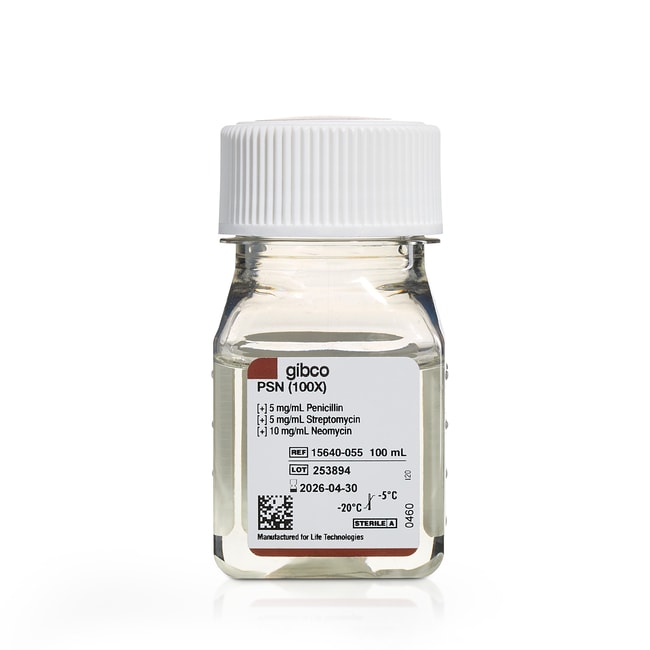
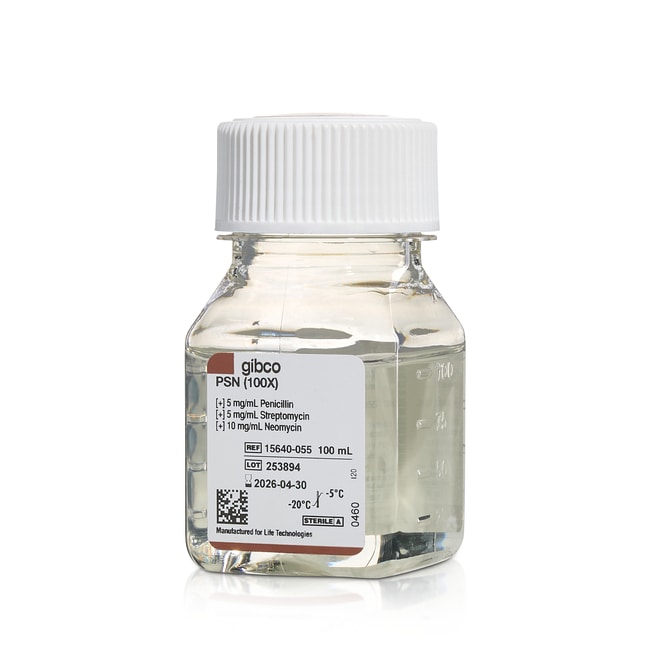
Gibco™ Penicillin-Streptomycin-Neomycin (PSN) Antibiotic Mixture

Description
Penicillin was originally purified from fungus Penicillium and acts by interfering directly with turnover of bacteria cell wall and indirectly by triggering the release of enzymes that alter cell wall. Streptomycin was originally purified from Streptomyces griseus and Neomycin from Streptomyces fradiae. Streptomycin and Neomycin act by binding to the 30S subunit of the bacterial ribosome leading to inhibition of protein synthesis and death in susceptible bacteria.
- Solution contains 5 mg of penicillin, 5 mg of streptomycin, and 10 mg of neomycin per ml in 0.85% saline
Cell Culture, Mammalian Cell Culture
Order Info
Shipping Condition: Dry Ice
Specifications
Specifications
| Content And Storage | Store in freezer (-5°C to -20°C). |
| Concentration | 100 X |
| Culture Type | Mammalian Cell Culture |
| Form | Liquid |
| Product Type | Antibiotic |
| Sterility | Sterile-filtered |
| For Use With (Application) | Prevention of Cell Culture Contamination |
| Quantity | 100 mL |
| Shipping Condition | Dry Ice |
Frequently Asked Questions (FAQs)
When an irreplaceable culture becomes contaminated, researchers may attempt to eliminate or control the contamination.
1. Determine if the contamination is bacteria, fungus, mycoplasma, or yeast. Read more here to view characteristics of each contaminant.
2. Isolate the contaminated culture from other cell lines.
3. Clean incubators and laminar flow hoods with a laboratory disinfectant, and check HEPA filters.
4. Antibiotics and antimycotics at high concentrations can be toxic to some cell lines. Therefore, perform a dose-response test to determine the level at which an antibiotic or antimycotic becomes toxic. This is particularly important when using an antimycotic such as Gibco Fungizone reagent or an antibiotic such as tylosin.
The following is a suggested procedure for determining toxicity levels and decontaminating cultures:
1. Dissociate, count, and dilute the cells in antibiotic-free media. Dilute the cells to the concentration used for regular cell passage.
2. Dispense the cell suspension into a multiwell culture plate or several small flasks. Add the antibiotic of choice to each well in a range of concentrations. For example, we suggest the following concentrations for Gibco Fungizone reagent: 0.25, 0.50, 1.0, 2.0, 4.0, and 8.0 µg/mL.
3. Observe the cells daily for signs of toxicity such as sloughing, appearance of vacuoles, decrease in confluency, and rounding.
4. When the toxic antibiotic level has been determined, culture the cells for two to three passages using the antibiotic at a concentration one- to two-fold lower than the toxic concentration.
5. Culture the cells for one passage in antibiotic-free media.
6. Repeat step 4.
7. Culture the cells in antibiotic-free medium for four to six passages to determine if the contamination has been eliminated.
Please view the following page to browse the cell culture antibiotics we offer (https://www.thermofisher.com/us/en/home/life-science/cell-culture/mammalian-cell-culture/antibiotics.html).
For Research Use Only. Not for use in diagnostic procedures.