Learn More
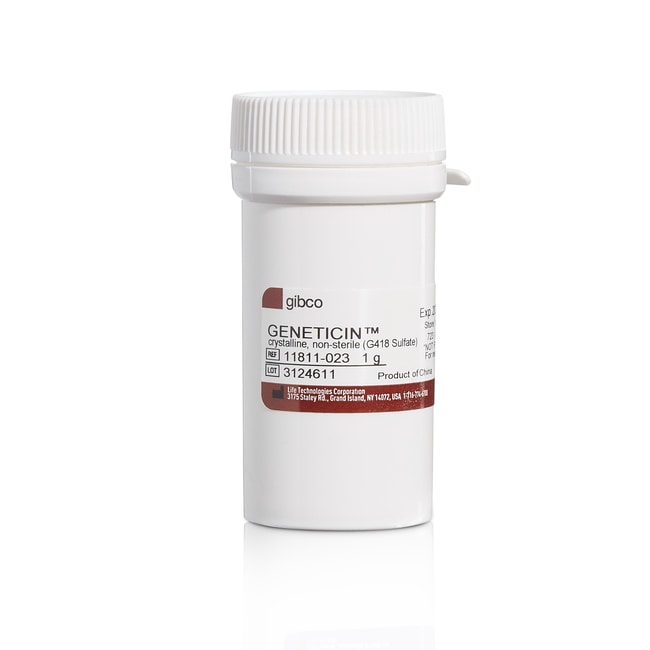
Gibco™ Geneticin™ Selective Antibiotic (G418 Sulfate), Powder

Description
Geneticin™ Selective Antibiotic (G418 Sulfate) is produced by the bacterium Micromonospora rhodorangea and acts by binding the ribosome, thus inhibiting protein synthesis in both prokaryotic and eukaryotic cells. Resistance to Geneticin™ Selective Antibiotic (G418 Sulfate) is conferred by the E. coli APH (3') – I and APH (3') – II resistance genes. Gibco™ Geneticin™ Selective Antibiotic (G418 Sulfate) is used as a selective antibiotic in the concentration range of 100 - 200 μg/mL for bacteria, or 200 – 500 μg/mL for most mammalian cells. This product is supplied as a powder and should be made into a stock solution of 10 – 50 mg/mL in water. We offer a variety of cell culture antibiotics for your convenience.
Product Use
For Research Use Only: Not intended for animal or human diagnostic or therapeutic use.
Dual site cGMP Manufacturing and Quality System
For supply chain continuity, we manufacture Gibco™ Geneticin™ Selective Antibiotic (G418 Sulfate) at two separate facilities located in Grand Island, NY and Scotland, UK. Both sites are compliant with cGMP manufacturing requirements, are certified to ISO 13485, and are registered with the FDA as medical device manufacturers.
Order Info
Shipping Condition: Room Temperature
Compliance
Manufactured at a cGMP compliant facility, which is registered with the FDA as a medical device manufacturer and is certified to ISO 13485 standards.
Specifications
Specifications
| Content And Storage | Storage conditions: 15 to 30°C Shipping conditions: Ambient Shelf life: 24 months from date of manufacture |
| Cell Type | Eukaryotic Cells, Prokaryotic Cells |
| Concentration | 10 to 50 μg/mL |
| Form | Powder |
| Product Type | Antibiotic |
| Sterility | Non-sterile |
| For Use With (Application) | Eukaryotic Selection/Stable Cell Line Generation |
| Product Line | Geneticin |
| Quantity | 1 g |
| Shipping Condition | Room Temperature |
Frequently Asked Questions (FAQs)
All of our antibiotics (Geneticin, Zeocin, Hygromycin B, Blasticidin, and Puromycin) can be used together for making multiple stable cell lines. However, kill curves will need to be performed for each combination of antibiotics since sensitivity to a given antibiotic tends to increase when combined with other antibiotics.
No, Neomycin is toxic to mammalian cells. It also causes irreversible damage to kidneys and other organs. Geneticin (aka G418 Sulfate) is a less toxic and very effective alternative for selection in mammalian cells. Neomycin can be used in bacterial selection, but Kanamycin is the preferred drug to use because of Neomycin's toxicity.
For best results, optimal concentrations for selection should be determined empirically in each unique experiment through dose response curves. However, to get a general idea of concentrations that have worked for individual cell types, please click on the following url: http://www.thermofisher.com/us/en/home/life-science/cell-culture/transfection/selection.html or type in “Selection Antibiotics” into our main search on www.thermofisher.com.
It is true that a percentage of non-resistant mammalian cells do not round-up from the plate upon Zeocin selection as would be seen with G418 or Hygromycin selection. However, one should see some very characteristic morphological changes occurring in those cells that are not resistant. These cells that stick to the culture dish typically display a vast increase in size. This could be best described as being similar to the effects of cytomegalovirus infecting permissive cells. The shape of these cells may also change; taking on an "alien" shape. On close examination of the non-resistant cells, the researcher should observe a distinct breakdown of both the nuclear and plasma membranes. Even though the "cells" are still attached to the plate, they should have the appearance of many holes in these membranes. Also, before the breakdown of the membranes, one can observe open areas in the cytoplasm of the cells that appear to be large, empty vesicles. Although not confirmed, this may be explained by a breakdown of the endoplasmic reticulum and Golgi apparatus, or other scaffolding proteins. Eventually, these "cells" will completely breakdown so that only "strings" of protein are left.
In contrast, Zeocin resistant cells should continue to divide at a regular interval to form distinct clumps of cells, or colonies. There should not be a distinct change in morphology, which can be compared to cells not under selection with Zeocin. It is these colonies of actively dividing cells that contain the resistance gene and are expressing it actively.
If there is concern about the dead cells sticking to the plate, one may do the following to eliminate them: Treat the plate for a couple of minutes with trypsin/versene. Both the healthy resistant cells and the dead cells will dislodge from the plate. The cells can then be replated (without Zeocin selection) and the healthy cells will attach again while the dead ones will not. After a couple of hours when the healthy cells have attached to the substrate again, Zeocin can be added back to the medium.
Blasticidin: Nucleoside Inhibits protein synthesis in prokaryotic and eukaryotic cells by interfering with peptidyl transfer reaction of protein synthesis, causing early termination of translation.
Geneticin (G418): Aminoglycoside Blocks protein synthesis in mammalian cells by interfering with ribosomal function.
Hygromycin: Aminocyclitol Inhibits protein synthesis by disrupting translocation and promoting mistranslation.
Zeocin: Intercalates with DNA and cleaves it.
For Research Use Only. Not for use in diagnostic procedures.