missing translation for 'onlineSavingsMsg'
Learn More

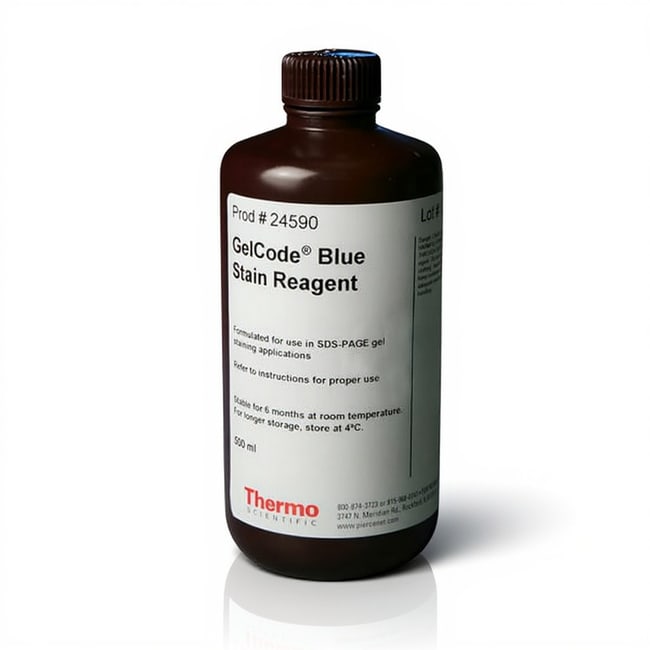
Thermo Scientific™ GelCode™ Blue Stain Reagent

Catalog No. PI24590
Change view
Click to view available options
Quantity:
500 mL
3.5 L
2 product options available for selection
Product selection table with 2 available options. Use arrow keys to navigate and Enter or Space to select.
Catalog No. Quantity
PI24590 500 mL
PI24592 3.5 L
Use arrow keys to navigate between rows. Press Enter or Space to select a product option. 2 options available.
2 options
Catalog No. PI24590 Supplier Thermo Scientific™ Supplier No. LSG24590
Only null left

GelCode Blue Stain Reagent is a ready-to-use protein stain based on colloidal coomassie dye G-250 that provides nanogram-level detection in polyacrylamide gels and for in-blot detection.

GelCode Blue Stain Reagent is a ready-to-use protein stain based on colloidal coomassie dye G-250 that provides nanogram-level detection in polyacrylamide gels and for in-blot detection. This unique reagent stains only protein and allows bands to be viewed directly in the gel during the one-hour gel-staining process.

GelCode Blue Stain Reagent is a ready-to-use protein stain based on colloidal coomassie dye G-250 that provides nanogram-level detection in polyacrylamide gels and for in-blot detection.

Features include:

  • No methanol-acetic acid destaining required
  • Fast, one-step, one-hour staining, ready-to-use stain reagent; band development visible directly in the staining tray; no background from overnight staining; flexible fixing and washing protocol; no gel shrinkage; stained gel can be dried
  • Water wash increases staining sensitivity; optional step provides crystal-clear gel background and makes weakly stained bands more visible

GelCode Blue Stain Reagent stains only protein and allows bands to be viewed directly in the gel during the one-hour gel-staining process. Because the destaining step does not fix the protein, GelCode Blue Stain is compatible with mass spectrometry analysis and N-terminal sequence analysis.

Specifications

Content And Storage Store at 4°C.
Detection Location In-Blot Detection, In-Gel Detection
Color Blue
Detection Method Colorimetric
Label or Dye Coomassie
Quantity 500 mL
Target Molecule Protein
Product Line GelCode
Product Type Protein Gel Stain
Does GelCode Blue Stain Reagent contain coomassie G-250 or R-250 dye and what is the difference?

GelCode Blue Stain Reagent contains coomassie G-250 dye. Coomassie G (green)-250 is greenish, stains bright blue, is less soluble and used in colloidal form (stain enters a protein better than the acrylamide, so background is minimized). Coomassie R (red)-250 dye is reddish, stains dark blue and is more soluble, usually resulting in high background.

Is there a faster staining method using GelCode Blue Stain Reagent?

Yes. The product instructions include a microwave procedure for faster staining with only a minimal loss in sensitivity. Protein bands can be detected approximately 30 minutes after electrophoresis.

Do any gel types require fixing before staining with the GelCode Blue Stain Reagent?

Yes. For gels electrophoresed with MOPS or MES running buffers, fix gel with 50% methanol and 7% acetic acid for 15 minutes and extensively wash with water.

Can a GelCode Blue Reagent-stained gel also be stained with silver stain?

Yes. The GelCode Blue Reagent-stained gel must be fixed overnight with 30% methanol and 10% acetic acid, followed by washing with water for 1 hour; then the gel is then ready for staining with a silver stain (e.g., Cat. No. 24612).

Can GelCode Blue Stain Reagent be used for isoelectric focusing (IEF) gels?

Yes. IEF gels can be stained, but they first must be fixed in 20% TCA for 30 minutes followed by washing with water for 30 minutes; then the gel can be stained as usual.

I am using the GelCode Blue Stain Reagent. Instead of performing the Water Wash Enhancement Step, may I destain with water/MeOH/acetic acid as I am used to doing with other coomassie stains?

Yes, any procedures that one ordinarily uses for coomassie-stained gels may be successfully performed on GelCode Blue Reagent-stained gels.

When I first started using this bottle of GelCode Blue Stain Reagent it worked well, but now it is not working. What's wrong?

The bottle contents must be mixed well before dispensing to ensure a uniform solution.

Why are the phosphoproteins in my sample not staining well with the GelCode Blue Stain Reagent?

Coomassie dye does not bind well to phosphoproteins or other hydrophobic proteins. When using these proteins, switch to a silver stain to see total protein.

Is sensitivity of the GelCode Blue Stain the same for all types of proteins?

No. Some proteins can be detected to 8 ng. Most proteins are detectable at 25 ng. Some proteins (e.g., phosphoproteins) do not stain well.

Can a Western blot be performed on a gel that has been stained with GelCode Blue Stain Reagent?

Yes; however, transfer and subsequent probing efficiency may be decreased in some systems.

Can membranes be stained with GelCode Blue Stain Reagent?

Yes. The product instructions include a procedure for staining membranes. Wash membrane for 1-2 minutes in water, stain for 2-5 minutes and destain with 50% methanol, 1% acetic acid. For best results staining membranes, use MemCode Reversible Protein Stains for Membranes (Cat. No. 24580, 24585).

Can I re-use the GelCode Blue Stain Reagent for multiple gels?

For best results, use the stain solution only once. Lower amounts of staining may result when the stain solution is used more than once, producing variable results.

Are mass spectrometry and sequencing possible after staining with GelCode Blue Stain Reagent?

Yes, see PNAS 98:12056-61 and J. Biol.Chem. 275:3462-8.

Why am I seeing no band development when using the GelCode Blue Stain Reagent?

A possible cause for no band development is that the gel is >1 mm thick. To resolve this problem, we recommend performing the water wash enhancement step for 2-4 hr (instead of 1-2 hr). Alternatively, thinner gels could be used.

Why is the GelCode Blue Stain Reagent turning blue during the staining process?

A possible cause for the reagent turning blue during the staining process is SDS (sodium dodecyl sulfate) interference. To resolve this problem, we recommend washing the gel extensively before staining.

Why am I experiencing high background when using your GelCode Blue Stain Reagent?

A possible cause for high background is SDS (sodium dodecyl sulfate) interference. To resolve this problem, we recommend washing the gel extensively before staining.

Can I stain my gel with Colloidal Blue Stain and then perform western blotting?

Yes, Colloidal Blue Stain can be used before western blotting. However, for optimal transfer efficiency, we recommend destaining the gel and then equilibrating in a series of Tris base/Glycine/SDS solutions to increase solubility; when the transfer is complete, the membrane should be treated with methanol to remove the stain prior to chromogenic development (not necessary prior to chemiluminescent detection).