missing translation for 'onlineSavingsMsg'
Learn More
Learn More
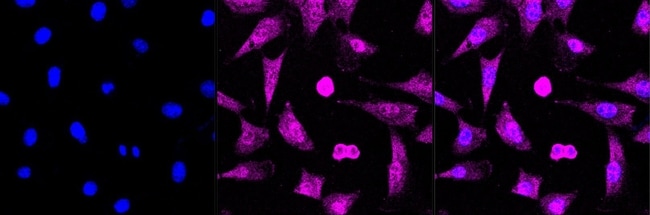
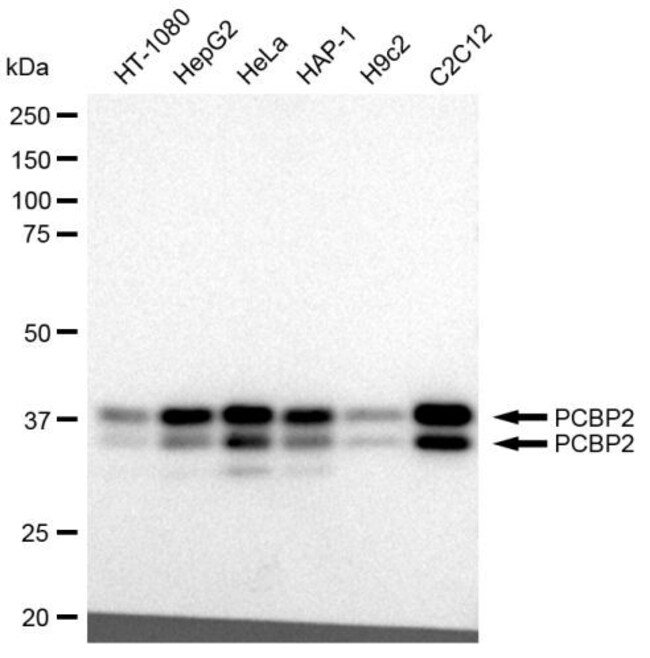
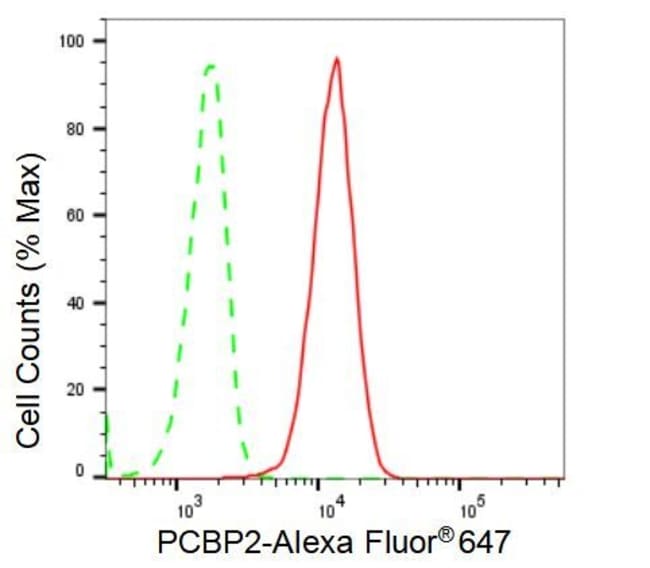
Invitrogen™ PCBP2 Recombinant Rabbit Monoclonal Antibody (23GB2110)

Rabbit Recombinant Monoclonal Antibody
$656.94 - $1,779.35
Spécifications
| Antigen | PCBP2 |
|---|---|
| Clone | 23GB2110 |
| Concentration | 1.5 mg/mL |
| Content And Storage | -20°C |
| Applications | Flow Cytometry, Western Blot, Immunocytochemistry |
| Numéro de catalogue | Numéro du manufacturier. | Quantity | Prix | Quantity & Availability | |||||
|---|---|---|---|---|---|---|---|---|---|
| Numéro de catalogue | Numéro du manufacturier. | Quantity | Prix | Quantity & Availability | |||||
|
MA553226
|
Invitrogen™
MA553226 |
100 μL |
chaque for $1,779.35
|
|
Connectez-vous ou enregistrez-vous pour vérifier votre prix et la disponibilité.
|
||||
|
MA553227
|
Invitrogen™
MA553227 |
20 μL |
chaque for $656.94
|
|
Connectez-vous ou enregistrez-vous pour vérifier votre prix et la disponibilité.
|
||||
Description
PCBP2 Recombinant Monoclonal Antibody for Western Blot, ICC/IF, Flow
The protein encoded by this gene appears to be multifunctional. Along with PCBP-1 and hnRNPK, it is one of the major cellular poly(rC)-binding proteins. The encoded protein contains three K-homologous (KH) domains which may be involved in RNA binding. Together with PCBP-1, this protein also functions as a translational coactivator of poliovirus RNA via a sequence-specific interaction with stem-loop IV of the IRES, promoting poliovirus RNA replication by binding to its 5'-terminal cloverleaf structure. It has also been implicated in translational control of the 15-lipoxygenase mRNA, human papillomavirus type 16 L2 mRNA, and hepatitis A virus RNA. The encoded protein is also suggested to play a part in formation of a sequence-specific alpha-globin mRNP complex which is associated with alpha-globin mRNA stability. This multiexon structural mRNA is thought to be retrotransposed to generate PCBP-1, an intronless gene with functions similar to that of PCBP2. This gene and PCBP-1 have paralogous genes (PCBP3 and PCBP4) which are thought to have arisen as a result of duplication events of entire genes. This gene also has two processed pseudogenes (PCBP2P1 and PCBP2P2). Multiple transcript variants encoding different isoforms have been found for this gene.Spécifications
| PCBP2 | |
| 1.5 mg/mL | |
| Flow Cytometry, Western Blot, Immunocytochemistry | |
| Unconjugated | |
| Rabbit | |
| RUO | |
| PBS with 50% glycerol and 0.02% sodium azide; pH 7.4 | |
| Q15366, Q61990 | |
| 18521, 363005, 5094 | |
| A synthesized peptide derived from human PCBP2 (257-300AA). | |
| Antibody |
| 23GB2110 | |
| -20°C | |
| Recombinant Monoclonal | |
| Liquid | |
| IgG | |
| Human, Mouse, Rat | |
| PCBP2 | |
| Alpha CP2; Alpha-CP2; alphaCP-2; AW412548; CBP; CTBP; fb36h02; Heterogeneous nuclear ribonucleoprotein E2; heterogeneous nuclear ribonucleoprotein X; heterogenous nuclear ribonucleoprotein E2; hnRNP E2; hnRNP X; HNRNPE2; hnRNP-E2; Hnrnpx; HNRPE2; Hnrpx; MGC110998; Pcbp2; pcbp2 protein; PCBP3; poly(rC) binding protein 2; poly(rC)-binding protein 2; Putative heterogeneous nuclear ribonucleoprotein X; rCbinding protein 2; wu:fb36h02; zgc:55964 | |
| PCBP2 | |
| Primary | |
| Affinity chromatography |